Mount Everest, the highest mountain in the world, has been the object of fascination of adventurers over the course of more than one hundred years. The North Face in Tibet offers a challenging and distinct challenge when compared to the North Col route in Nepal, which is more famous. It is a path, full of history and untamed, harsh loveliness, which gives us another sort of journey to the summit of the earth.
To a lot of serious mountaineers, the Everest North Side climb is a purer and more challenging test of skill, endurance and spirit. This guide will touch upon all aspects of the North Face Everest route, including the geography and history of the route, as well as its massive challenges and preparations.
Introduction to the North Face of Everest
Mount Everest is an astounding 8,848.86 meters (29,031.7 feet) above sea level, a giant pyramid of ice and rocks between Nepal and China. Although thousands have been inclined to its peak, the route they follow would greatly influence their experience. Tibetan-side to the north Face The North Face can frequently be deemed the more challenging and hazardous of the two common routes.
Why is it so challenging? The path subjects the climbers to elevated average altitudes and the length of time spent in the climbers’ area, a greater duration of bad weather and an additional technical landscape on the final ascent to the peak. The Everest expedition on this side is characterized by brutal winds, excruciating cold and a psychological struggle with the huge empty terrain. The North Face Everest challenges do not only involve physical elements but a deeper one as well; it is an ultimate test of the determination of a climber.
Geography and Location of the Everest North Face
The Everest of the North Face is located in the territory of the Tibet Autonomous Region of China. It takes a long time before one touches the mountain, and an overland adventure through cities such as Lhasa or Kathmandu to the Chinese Base Camp. This is a step-by-step, although rough, process of acclimatization as you cover the immense Tibetan Plateau.
There are prominent milestones that characterize the climb. The path begins at the Chinese Base Camp (CBC) at some 5,200 meters (17,060 feet). Then these climbers walk to Advanced Base Camp (ABC), which is on the base of the Rongbuk Glacier at an enormous height of 6,400 meters (21,000 feet). It is among the base camps in the world. The ascent continues to the North Col, a steep-sided chute on the crest between Everest and her neighbor, Changtse. The North Side of Everest location is of significantly different appearance and geology than the Nepal side, which is predominantly made of sedimentary rocks and massive glaciers.
North Face Expeditions History
The timeline of the North Face is the timeline of the initial exploration of Everest. Prior to the opening of Nepal’s borders in 1950, all the effort on the summit was done on the Tibetan side. British people were the first, and they initiated expeditions in the 1920s and 1930s.
The best known of these early efforts was the 1924 British expedition, which concluded in one of the greatest mysteries in the whole history of mountaineering. The last sighting of George Mallory and Andrew “Sandy” Irvine was heading well to the summit on the Northeast Ridge and a few hundred meters above it, which was so high that they were going well.
They got lost in the clouds, and no one ever saw them alive again. The question of whether they were able to reach the summit before death is a burning issue. In 1999, the body of Mallory was found, whereas Irvine and the camera that they were using were missing.
In 1960, a Chinese team became the first official climbers of the North Face side of Everest. A final desperate effort by Wang Fuzhou, Gonpo and Qu Yinhua was made in the dark, with no oxygen, establishing a milestone in the history of mountaineering. Their success then paved the way for the history of Everest’s North Face in the future.
The North Face Climbing Routes
Although there are some technical paths available, most of the climbers use the normal path that is through the Northeast Ridge.
Normal Route (North Col to Summit)
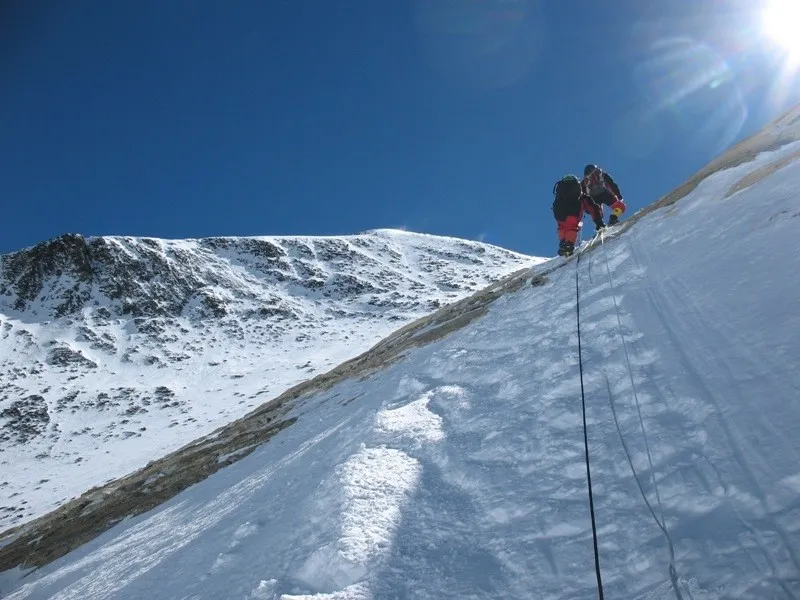
The Everest North Face normal route is a strategy game, which involves successive higher camps. Once acclimatized, the climbers use the fixed ropes up the steep ice wall of the North Col to Camp 1 at approximately 7,000 meters (23,000 feet) after acclimatization at ABC. This part is an important challenge and a fair measure of the preparation of a climber.
North Col The trail goes on along the long, icy snow slopes of the Northeast Ridge. Camp 2 is normally set up at 7,500-7,700 meters (24,600-25,260 feet), whereas the last high camp, Camp 3, is located at an altitude of about 8,300 meters (27,230 feet). This camp is too high and has limited relief against the elements.
The final test is the summit push commencing at Camp 3. A rocky and exposed trail leads to the top of the Three Steps, where climbers make their way. They are three mainstream rock bands that present the last technical challenges. The most well-known and famous crux of the climb is the Second Step, a near-vertical rock face 8,610 meters (28,250 feet). This is overcome by a ladder that was initially installed in 1975 by the Chinese and replaced. There is a snow pyramid above the Third Step, which is the terminal one to the summit.
Alternative and Technical Routes
To the elite alpinists, the North Face has more direct and hazardous routes. The Norton Couloir or the Great Couloir, is a colossal gully that cuts the face. In 1924, Edward Norton successfully traversed this couloir to an altitude of 8,570 meters by high-altitude standards, without any supplemental oxygen, a record that remained for decades.
Other technical routes to the North Face of Everest, such as the Japanese Couloir to the Hornbein Couloir, are extreme expeditions that only highly skilled risk-takers can attempt to undertake. These difficult ascent climbs encompass steep ice, mixed rocks and snow, and a high probability of avalanches, which require global standard technical expertise.
Comparison with South Face Route
The debate between Everest’s South and North Faces is the center of attention when climbers have to weigh their choices. The South side, which is through Nepal via the Khumbu Icefall, tends to be warmer and less windy. It has fewer summit days and less time in extreme altitudes. Nonetheless, the Khumbu Icefall is an objectively risky and unstable maze of moving seracs.
The North is colder with a longer and more technical peak day with more wind. The last ascent under the ridge and the Three Steps have greater technical difficulty than the Hillary Step on the South (which had fallen in 2015). The drive-in approach to the Tibetan Base Camp is logistically less complicated than the multi-day hike that would be necessitated on the Nepal side. However, it may ultimately rest on a weighing of the odds: the objective danger of the Icefall on the South as compared to the prolonged exposure to the extreme altitude and climate on the North.
Difficulties of the North Face climbing
The threats on the North Face are extreme and incessant. The main antagonist is weather. Gale-force winds are often hurled upon the mountainous slopes by the jet stream and the temperature can drop to -40°C or less. The climbing season is short-lived, usually limited to a few weeks during the month of May when the winds abruptly calm down.
This increases the high-altitude risks. The path exposes the climbers to more than 8,000 meters or the death zone. Avalanches are a common menace on the slopes approaching the North Col and beyond, which are so frequent that they may not be very frequent elsewhere in the Khumbu. The East Rongbuk Glacier is full of crevasses. The low temperatures raise the chances of frostbite, and the thin air makes all the physical activities exhausting and increases the chances of Acute Mountain Sickness (AMS), HACE, and HAPE. The physical and psychological needs are enormous; the climbers have to be in concentration and perform intricate tasks in the environment that is actively against human survival.
Training to Climb the North Face
The North Face is the top and successful climb of the mountain after years of training. It commences by securing a Tibet climbing permission with China Tibet Mountaineering Association (CTMA). The expedition operator handles this process and it is at times more more difficult and unpredictable than obtaining a permit in Nepal. Fitness cannot be compromised. The optimal workout program is one that is oriented toward
heart vigor, power, and energy. This will involve running, cycling, swimming, and hiking heavily. packs in hilly areas. Prior experience in elevated altitude, preferably on a mountain above 8,000 meters, is critical. Acclimatization is the very essential thing and the gradual nature of the approach to the North side gives time to the body to go through gradual adjustment.
The necessary equipment is a down suit, triple-layer boots, high-altitude gloves and mittens, and specific mountaineering equipment, i.e. an ice axe, crampons, and a harness. All the Everest climbing equipment should be of quality. The majority of the climbers are a part of a commercial expedition that offers them logistical support, guides, and seasoned Sherpas. It is strongly advisable that additional safety and support be hired with a personal Sherpa.
Notable Ascents and Records
North Face has been a venue to some of the most incredible achievements in the world of mountaineering. In 1980, Reinhold Messner became the first person to make an unaccompanied climb of Everest, through a new route on the North side and without oxygen supplementation. His lightweight-style absence was bold and it reinvented the possibilities.
Other Everest North Face records are the astounding achievement in 1986 by two Swiss climbers Erhard Loretan and Jean Troillet, who made a one-time 43-hour push to the North Face Hornbein Couloir without oxygen, ropes, and tents. Over the past few years, speed records have been broken, with some climbers climbing the summit in less than 24 hours since ABC. These exploits highlight the timeless popularity of the mountain to those who explore the extent of the human potential.
Environmental and Cultural Ideals
The North Face is not only a physical but also a cultural and environmental journey. It is a path that cuts across a land that is full of Tibetan culture. The monastery named Rongbuk, situated close to Base Camp, is the world’s highest monastery and very spiritually important. Climbers are the visitors of such a landscape and they have to respect local customs.
There has been an increase in environmental effects of expeditions. Over the years, the North side has been marred with the litter remains of oxygen bottles, tents, and other waste. The CTMA has responded with stringent policies, one of them being a pack-in, pack-out policy. Sustainable climbing is now enforced by responsible trekking and mountaineering practices. The conservation activities are aimed at the south in conserving the delicate ecosystem of the alps and making the mountain stay as a site of pure beauty.
Conclusion: Why the North Face of Everest is Iconic
The North Face of Everest is not only a climb but also an adventure into the depths of the history of mountaineering and a battle against the bare strength of nature. It is its hardships, the unstated wind, the extreme cold, and the technical troubles that are extremely high in the death zone that make it an icon. It is not as loud, more stark and, perhaps, deeper than its southern counterpart. To the courageous ones who have decided to climb Everest’s North Face it, it can be seen that the trip is an honor to the people who initially dared to dream of the mountain and a strong reminder that the highest mountain in the world should be approached with the highest degree of respect and humility.
FAQs
1. Where Exactly Is the North Face of Mount Everest?
It lies in the Tibet Autonomous Region of China, facing north from the summit ridge, near Rongbuk Monastery.
2. How High Is the North Base Camp?
The North Base Camp is at an altitude of 5,150 meters, making it one of the highest vehicle-accessible points in the world.
3. Can Tourists Visit Without Climbing?
Yes. Visitors can travel by road to the Base Camp area and enjoy clear views of Everest without any technical climbing.
4. What Makes the North Face More Difficult Than the South?
It is colder and windier and has more technical rock sections. The route is also longer and exposed to stronger winds.
5. Who First Reached the Summit From the North Face?
A Chinese expedition in 1960 made the first successful ascent via this route.
6. What Is the Best Time to Visit the North Face?
April to May and September to October are ideal, offering clearer skies and more stable weather.
7. How Cold Does It Get?
Temperatures can drop below –20°C at Base Camp and much lower at higher elevations.
8. What Permits Do I Need?
Foreigners require a Tibet Travel Permit, an Alien Travel Permit, an Everest Base Camp Permit, and a climbing permit for summit attempts.
9. Are Oxygen Bottles Necessary?
Climbers need supplemental oxygen above 7,000 meters, but trekkers at Base Camp do not.
10. Is Medical Help Available?
Basic medical support is available at Base Camp, but serious emergencies require evacuation to Lhasa.
11. Are There Communication Facilities?
Satellite phones and limited internet connections are available in Lhasa and Shigatse, but rarely at higher camps.
12. Can Drones or Photography Equipment Be Used?
Drones require special permission from Tibetan authorities. Cameras are allowed but must be used respectfully near monasteries.
13. Is Travel Insurance Required?
Yes. High-altitude insurance, which includes emergency evacuation coverage, is mandatory for climbers and highly recommended for trekkers.
14. How Do I Prevent Altitude Sickness?
Ascend slowly, take acclimatization days, and use medication like Diamox if needed. Stay hydrated and rest frequently.
15. Why Do Fewer Climbers Choose the North Face Route?
The North Face is technically more challenging, colder, and riskier. Rescue options are limited, and permits are more restricted, making it less popular despite its historical value.