At high altitude, the organization behind your trek matters more than most people recognize. The right team handles permits, monitors your health, includes your load, and knows when to push ahead or pull back. The wrong one leaves you figuring that out on your very own.
You have done your research. You recognize the gap, you’ve seen the snapshots, and you have already seen what Kala Patthar looks like at dawn. The decision to trek to Everest Base Camp has already been made. Now comes the element most first-timers forget: who you do it with.
This explains what Nepal Outdoor Expeditions, a government-licensed Kathmandu-based enterprise with over 20 years of experience inside the Khumbu region, really offers, what’s included in the package deal pricing, and what you absolutely need to know before you leave.
Trek at a Glance
- Standard Duration: 12 days
- Starting Price: From $1,300/person
- Max Altitude: 5,545 m (Kala Patthar)
- Difficulty: Moderate to challenging
- Best Months: Oct, Nov, Mar, Apr, May
- Group Size: 8–15 trekkers
- Start / End: Kathmandu (Lukla flight)
- Permits Required: TIMS + SNP + Khumbu permit
What Is the Everest Base Camp Trek?
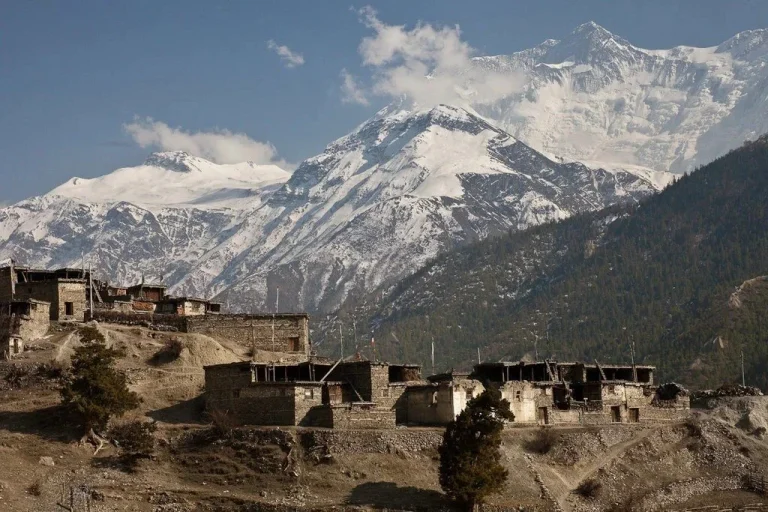
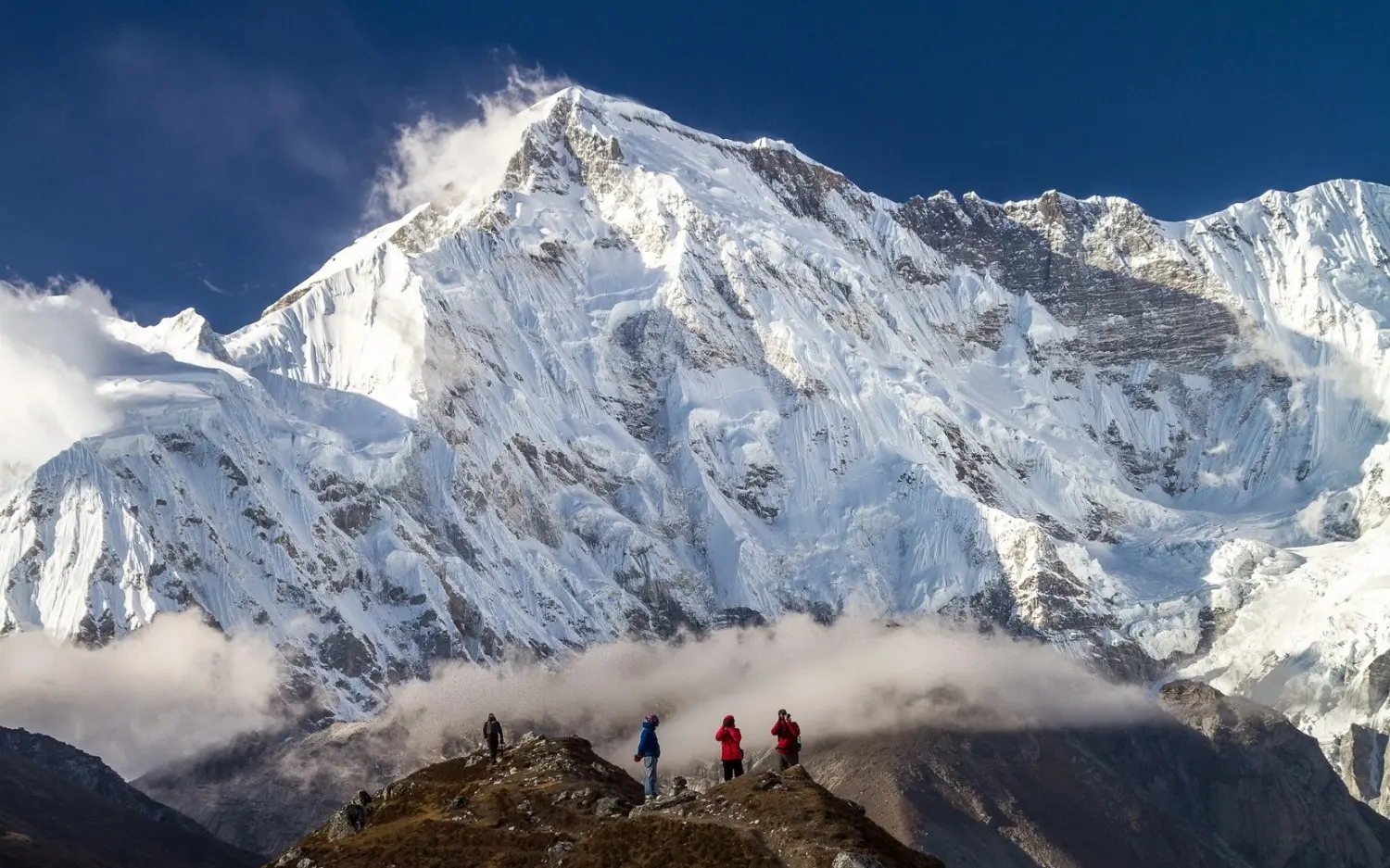
The Everest Base Camp trek is one of the most renowned long-distance treks in the world. The trek covers approximately 130-140 kilometers round trip, beginning in Lukla and passing through Sherpa villages, river valleys, alpine meadows, and glacial landscapes before reaching Everest Base Camp.
The regular route takes 12 days, with scheduled acclimatization at Namche Bazaar and Dingboche. These rest days do more than fill time. They help your body adapt to the thinner air, and not using them greatly increases the chances of altitude sickness.
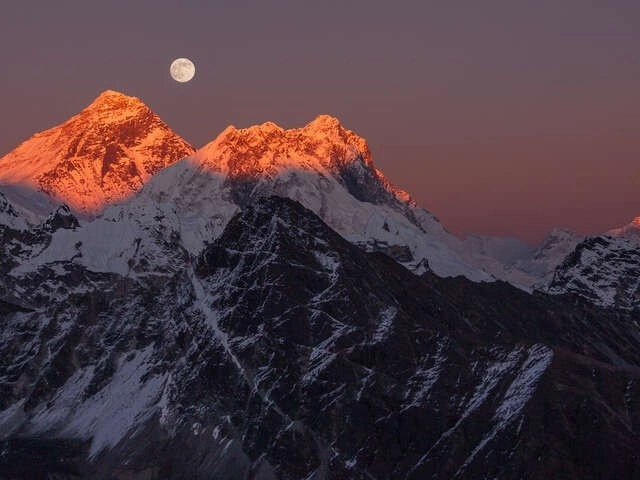
You pass several key points along the trail, including Tengboche Monastery and the village of Lobuche. And then Gorak Shep until you get to the Everest Base Camp. Many trekkers hike up to Kala Patthar as well, at 5,545 meters. From there, you can watch the sunrise over Everest, Nuptse, Lhotse, and Pumori. Trekkers often describe the cold, steep early morning climb as one of the best experiences of the trek.
The trek feels moderately difficult. You do not need mountaineering abilities. However, you need good fitness. You can expect to walk 5-7 hours daily on rough terrain for nearly two weeks.

Key Highlights of the Trek
This overview shows what you will find at each of the major stops:
- Lukla (2,860 m): Your expedition begins with a brief yet dramatic landing at Tenzing-Hillary Airport, which people in aviation widely discuss. It is here that you are introduced to your guide team and begin walking.
- Namche Bazaar (3,440 m): Namche is a bustling Sherpa town and serves as the main center of the Khumbu region. Shops, bakeries, and your first acclimatization day, including a morning walk to the Everest View Hotel, where the mountain reveals itself for the first time.
- Tengboche Monastery (3,860 m): Beautiful monastery overlooking Ama Dablam with Everest and Lhotse in the background. If you visit in the evening, the prayer service is worth attending.
- Dingboche (4,360 m): Open fields, thin air, and Island Peak and Lhotse views. One more acclimatization day, at Nagarjuna Peak or via Cho La Pass.
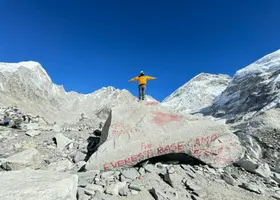
- Everest Base Camp (5,364 m): Colorful expedition tents, the Khumbu Icefall roaring, and Everest above it all.
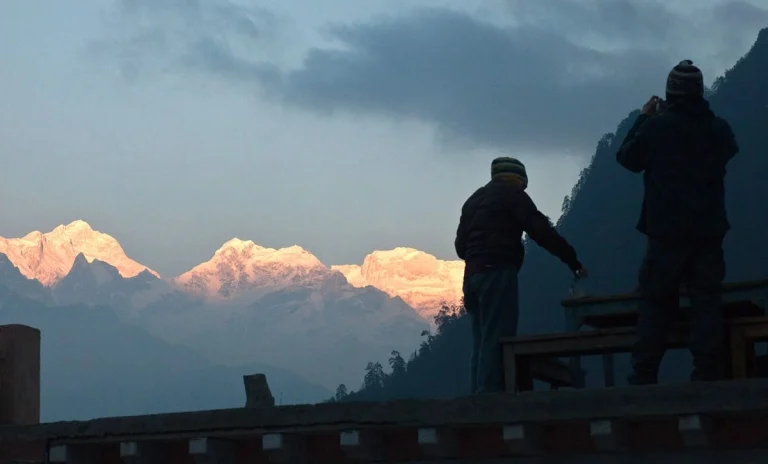
- Kala Patthar (5,545 m): The highest point of the trek. Get up early in the morning and see the sunrise touch the mountains around you all at the same time.
About Nepal Outdoor Expeditions
Nepal Outdoor Expeditions has been running trekking and expedition tours from Kathmandu for over 20 years. The company is government-licensed and fully insured, with a team of certified guides and local staff who know the Khumbu region from years of working in it, backed by years of hands-on experience in the Khumbu region.
In practical terms, this shows up in how treks are managed: permits handled properly, guides and porters paid fairly and insured, local teahouses used along the trail, and honest pricing with nothing hidden.
- Safety first, always. All guides carry certified first aid kits and pulse oximeters. Altitude monitoring is part of every day on the trail, not an extra service.
- Real experiences, not shortcuts. Routes are planned around proper acclimatization and meaningful cultural stops, not just getting trekkers to Base Camp as quickly as possible.
- Environmental responsibility. Reusable water bottles are encouraged, plastic waste is minimized, and teahouses using solar energy are preferred wherever available.
- Honest pricing. What is included is stated clearly upfront. No extra charges appear mid-trek.
What Nepal Outdoor Expeditions Offers
A lot of agencies advertise a low price and add costs later. But at Nepal Outdoor Expeditions, you will be assured of a completely transparent pricing structure. The 12-day Everest Base Camp package from Nepal Outdoor Expeditions is priced from $1,300 per person. Here is exactly what that covers from day one.
What We Offer:
- Airport pick-up and drop-off in Kathmandu
- All domestic flights (including the Lukla flight) and airport taxes
- Standard meals three times a day during the trek
- A government-certified, licensed guide
- One porter shared between two trekkers, with proper gear, food, accommodation, and insurance.
- Teahouse accommodation throughout the trek
- All required permits: TIMS card, Sagarmatha National Park entry permit, and Khumbu Pasang Lhamu Rural Municipality permit
- A comprehensive first aid kit with a pulse oximeter
- All government taxes and official expenses
Worth noting: Permits, porter insurance, and guide salaries are all built into the base price above. Some agencies advertise lower numbers but charge them separately later. With Nepal Outdoor Expeditions, what you see is what you pay.
Want a breakdown of what this costs in your currency, or a custom package?
Reach out on WhatsApp (+977 9767998270) or send a message here. No commitment needed, just honest answers.
Why Many Trekkers Choose to Book Through a Kathmandu Agency
You can complete the Everest Base Camp trek on your own. But most trekkers who have done it will tell you that going with a reputable agency makes the whole experience smoother, safer, and more enjoyable. Here is why Nepal Outdoor Expeditions specifically makes a difference. You can complete the Everest Base Camp trek on your own. Most trekkers recommend going with a reputable agency. It makes the experience much easier.
Here’s why:
- The agency processes licenses for you. The Sagarmatha National Park entry permit and the Khumbu Pasang Lhamu Rural Municipality permit. Both permits are mandatory and may take time to organize if you are not used to the procedure. An efficient agency can handle this without any hassle.
- Guides make the path safer. Your guide will monitor altitude symptoms daily. Guides monitor trekkers daily using pulse oximeters and symptom checks. They know when you should push forward or rest. They also have emergency contacts and satellite communication to coordinate the evacuation.
- Porters protect your knees and strength. Every kilogram matters at high altitude. Having a porter carry your main bag allows you to focus on walking comfortably and acclimatizing properly.
- Local knowledge does pay off. A Khumbu guide is familiar with which teahouses. They understand trail conditions. They also recognize altitude issues early.
- Small groups, not mass tours. Groups at Nepal Outdoor Expeditions typically run between 8 and 15 trekkers. Large enough for good company around the teahouse dinner table. Small enough that you still feel like yourself on the trail.
Everest Base Camp Trek Variations Available
Not everyone has the same timeline, budget, or fitness level, and Nepal Outdoor Expeditions has designed its offerings with that in mind. Here are the different ways you can experience the Everest region with them.
Budget Everest Base Camp Trek
The Budget Everest Base Camp Trek is for travelers who want a cost-effective way to complete the trek. It offers the full Everest Base Camp experience. It keeps costs low without compromising safety or guidance.

- A licensed, government-certified guide and a porter to carry your main bag are still there, so the basic support system remains the same.
- You will find comfortable but simple teahouses along the ordinary EBC trail, and that is where most of the interest of the trail is anyway.
- The trek follows the same popular route via Namche Bazaar, Tengboche, Dingboche, and Base Camp with adequate acclimatization days.
- This option works well for backpackers among the backpackers, younger travelers, or anyone who feels that they would rather spend their money on the experience than on niceties.
Luxury Everest Base Camp Trek
In case you would wish to think twice about where you lie sleeping after a long day of walking, the luxury version handles that for you. The same mountains, greater comfort.
- You stay in the best available teahouses and lodges. You often get priority for rooms. These offer better bedding and cleaner facilities.
- The food quality improves as well, and there is more choice and quality food that is chosen all along the trip.
- You receive a better guide-to-trekker ratio and individual consideration, which counts when you are at altitude and fatigued.
- This trek suits travelers who want who wishes to push themselves on the trail all day and really recuperate and relax well at night, not to rough it in all its senses.
Everest Base Camp Trek with Helicopter Return
Now the Everest Base Camp Trek with Helicopter Return is a popular choice, with a reason. You get to walk up all the way to Base Camp and then fly down, omitting the lengthy walk down and seeing the whole Khumbu region in a bird’s-eye view.

- You can complete the trek in 8 days. This suits travelers with limited time. It still allows proper acclimatization.
- The helicopter flight offers a bird’s-eye view of the Himalayas. Most trekkers never experience this view.
- It saves your knees, too. Everest Base Camp to descent is a beautiful but a long way to go, and in some cases, particularly for those who are jointly problematic, it is always prudent to fly back.
- It is priced above the normal trek at USD 2,650 and would be worth serious consideration due to the fact that the trekking experience and the scenic flight back would be the best combination ever.
Everest Base Camp Trek via Gokyo Lake
This region gives you more than just the base camp trail. The Everest Base Camp Trek via the Gokyo Lake route will provide you with more of Everest. It will lead you to the Gokyo Valley, which is among the most scenic and least congested regions of the entire Khumbu region.
- This route includes the Gokyo Lakes. These are high-altitude glacier lakes above 4,700 meters. Their turquoise color looks almost unreal to you.
- Gokyo Ri, the highest point in the area, offers a panoramic view of four 8,000-meter peaks, Everest, Cho Oyu, Lhotse, and Makalu, all of which can be seen as a single vantage point.
- It costs less than the standard route but offers you more of the Himalayas at 13 days with a relatively small difference in time and cost.
- It is an excellent option when one has already completed the classic EBC route and is looking to see it in a new light, ht or for a first-time visitor who just wishes to explore the area more thoroughly at the beginning.
Everest Three High Passes Trek
The Everest Three High Passes trek is the path that trekkers should follow to challenge themselves. Three mountain passes of high altitude, dramatic altitude change, and some of the most remote and breathtaking terrain the Khumbu has to offer.
- The route crosses through Kongma La (5,535 m), Cho La (5,420 m), and Renjo La (5,360 m). These passes challenge trekkers technically and require good fitness and previous trekking experience at elevation.
- You still reach Everest Base Camp and Kala Patthar, so you do not miss the iconic highlights; just augment them with a serious physical and scenic challenge.
- This trek offers the most comprehensive way to explore the Everest region on foot; it includes the most terrain that most trekkers on the standard route never see; at 15 days and 1,750 USD, it is the most inclusive of the Everest region.
- This trek is ideal for those with some high-altitude trekking experience and who are ready to be stretched out of their comfort zone.
5-Day and 10-Day Everest Base Camp Trek
The full itinerary is not always possible. We design shorter itineraries for travelers who have a tight schedule or those who have been to the Khumbu before and are aware of the route, and do not require the full buildup.
- The 5-day trip is a quick-paced one, which will cover the highlights of the region without being on the trail for 2 weeks. It is most effective with repeaters who have already become accustomed to altitude.
- The 10-day one is a more moderate solution, with the key destinations on the EBC route, but the more leisurely accumulation days are cut.
- Both options include a certified guide, porter service, permits, and meals, and thus, the basic framework of a well-organized trek remains intact.
- When you are short on time, these shorter packages are not a compromise, as long as you enter into it with realistic expectations of pace and acclimatization.
Not sure which option fits your schedule?
Share your available dates, and we can suggest the right variation. Get in touch here or message us on WhatsApp (+977 9767998270).
Practical Things You’ll Actually Want to Know
Best time to go
| Season | Months | Conditions | Rating |
|---|---|---|---|
| Autumn | Sep-Nov | Clear skies, best mountain views. October is the peak window. | Best |
| Spring | Mar-May | Rhododendrons in bloom, the Everest climbing season adds energy to the trail. | Best |
| Winter | Dec-Feb | Very cold above 4,000 m. Icy sections. Possible for experienced trekkers. | Possible |
| Monsoon | Jun-Aug | Heavy rain, obscured views, and frequent Lukla flight cancellations. | Avoid |
Read Article: Best time to trek to Everest Base Camp from the USA.
Difficulty level
The honest answer is that it is moderately challenging, yet it is the elevation that makes it tough, not the land as such.
You do not need climbing skills. It is a footpath all the way along. But expect to walk approximately 5-7 hours a day on rough, rocky surfaces for almost two weeks. You will feel it in your legs, and even more in your lungs, up to 4,000 and above, which is when the air becomes very thin.
The cumulative fatigue is what first-timers tend to underestimate. Single days do not necessarily come in extreme forms. It’s the back-to-back nature of them at increasing altitude that builds up. This is precisely the reason why the acclimatization days in Namche Bazaar and Dingboche are not negotiable.
Fitness is important, but so is mental resilience. Somewhere around Lobuche or Gorak Shep will be a hard day. That’s normal. Plod through it slowly, and everything falls into place when you are on Kala Patthar with the sunrise striking Everest.
Accommodation on the trail
Teahouses line the trail, and when you get used to the rhythm of these teahouses, they become one of the best things about the experience.
Imagine them as mini-mountain guesthouses, managed by local Sherpa households. There are no luxuries in the rooms: wooden bed frames, thin mattresses, communal washrooms, and hot water after a certain level. At the top of the trail, hot water to wash your face is like a luxury.
The lack of comfort in teahouses is compensated for by the atmosphere. In the dining rooms, the trekkers of various nationalities will be seated at the same table at the end of each day, where they will share stories and warm up with ginger tea and dal bhat. The atmosphere feels very social and very sincerely warm in a manner none of the hotels would have been able to duplicate.
There is variation in quality on the route. The coziest options are at Namche Bazaar. Farther north, living is more primitive, and food costs more since all is brought up the mountain by porter or yak.
Connectivity
You can stay connected, but it is not as you do at home.
Ncell and Nepal Telecom have mobile access in the majority of the main routes. The signal is weak at higher altitudes and is functional enough to make calls and send messages throughout much of the hike. Get a local Kathmandu SIM card on your way out. It is cheap, easily accessible in the Thamel region, and much better than international roaming.
Most teahouses offer Wi-Fi in most teahouses, but don’t expect much. It is generally slow, can be expensive, and photos will post or will not post at all. A quick message home to say that you are safe is okay most of the time.
Bring a power bank. The teahouses have charging points, but not all rooms, and cold weather has a higher charge on the battery than on average. During the day, keep your phone close to your body in order to preserve it.
Money
You must carry cash on this trek. Leaving Kathmandu, you will not have reliable ways to pay with cards or withdraw money, and you will only have what you bring.
All the prices in the trail are in Nepalese Rupees (NPR). Food and drinks outside your package, hot showers, Wi-Fi, snacks, additional drinks, and tips are all to be paid in cash. Sort this out before you head up.
In Kathmandu, you can find ATMs, especially in the Thamel region. One at Lukla, too, but not to be reckoned on. There is a withdrawal limit on the different machines, and each transaction attracts approximately USD 5 on top of what your home bank charges.
Allow a withdrawal in Kathmandu that will sustain your entire trek budget, and also a small additional amount in case of unforeseen expenses. The last thing you want is to run out of cash in a village above 4,000 meters; it is a stressful event and very avoidable.
Visa
Tourist visas are available on arrival at Tribhuvan International Airport in Kathmandu. The process is generally smooth and fast. Options include 15-day ($30 USD), 30-day ($50 USD), and 90-day ($125 USD) multiple-entry visas. Most EBC trekkers choose the 30-day option. Ensure your passport is valid for at least six months from the date of arrival, and carry some USD cash for the visa fee.
Travel insurance
You must have travel insurance for this trek. It is one of the most significant items you organize before going, and the information is more important than you might think.
You must have a policy that gives clear coverage on helicopter evacuation up to at least 5,500 meters. Many standard travel insurance policies will limit their coverage to significantly lower altitudes or none at all in high-altitude trekking. Always read the fine print before purchase. An uninsured helicopter rescue in the Everest area will cost USD 3,000 to USD 10,000 and above. Altitude sickness, slips, falls, and weather-related emergencies can occur, and cold-related injuries can occur on this trail. The right insurance is that, in case something happens, you will not worry about the bill.
Confirm the coverage details directly with your insurance provider. Inform them that you are climbing the Khumbu Valley to 5,545 meters at Kala Patthar, and you require helicopters to carry you down. Request a written confirmation prior to finalizing anything.
Where We Are Located
Most of the Everest Base Camp treks start in Kathmandu, where we are located. The city-based aspect of our services implies that we set all your pre-trek logistics in a single location: airport collection, permit application, equipment recommendations, briefings, and domestic flight organization for the Lukla trip.
You may contact us at Nepal Outdoor Expeditions or even through WhatsApp +977 9767998270. Any questions that you have are welcome before you commit to anything.

Frequently Asked Questions
1. Do I need trekking experience to book with Nepal Outdoor Expeditions?
No prior trekking experience is required. Good fitness matters more than experience. The Everest Base Camp trek is open to novices, so long as you prepare physically. We advise starting a training routine 2 to 3 months before departure: every day, aerobic, leg strengthening, sporting activities, and weekend hikes with a loaded backpack. The better conditioned you are, the more you’ll experience the experience rather than simply survive it.
2. What if someone in the group gets altitude sickness?
Our guides monitor symptoms daily and can coordinate helicopter evacuation if needed via satellite communication. Guides carry pulse oximeters and test oxygen saturation ranges at each camp. If someone shows caution signs, the guide will lessen the tempo, encourage relaxation, or make the call to descend to a lower altitude. In a serious scenario, helicopter evacuation may be arranged using satellite communication. This is why travel coverage masking helicopter evacuation to at least 5,500 m is a mandatory requirement for all trekkers, not a formality.
3. Can I join the trek as a solo traveler?
Absolutely. Solo travelers are welcome on any scheduled group departure. Absolutely. We welcome individual travelers to join our scheduled group departures, and many of our trekkers do just that. We always make our groups small, typically 8-15 individuals, such that even when a large tour is shared, it does not seem congested. The trail has a way of uniting people, even the most solo trekkers. Before you visit Namche Bazaar, you will have hiking friends, meals to share, and tales to exchange at the teahouse dinner table. It’s one of the more social experiences you can have as a solo traveler.
4. What if my Lukla flight gets delayed?
Build 1 to 2 buffer days into your schedule. The Ramechhap route is available as an alternative. Flight delays to Lukla are commonplace due to mountain weather. Fog, low visibility, and wind frequently motivate cancellations. Building buffer time into your arrival agenda method, a postponement does not disrupt the bottom of your entire trip. We additionally provide access to the Ramechhap path: a 3 to 4-hour flight from Kathmandu to Ramechhap Airport, followed by a shorter flight to Lukla. During peak season, Ramechhap usually has more favorable morning flying conditions and fewer cancellations.
5. Is $1,300 the total cost I should budget?
No. The $1,300 covers the trek itself. International flights, visa, insurance, and personal spending are on top of that. The bundle charge covers the whole thing for the trek: guide, porter, all lets in, food, teahouse accommodation, and home flights, along with the Lukla flight. Separate expenses include international airfare to and from Kathmandu, Nepal, traveller visa costs (USD 50 for 30 days), travel insurance with evacuation insurance, and personal trek spending, together with snacks, extra beverages, and tips for your guide and porter. Your overall price can be better than $1300. We are glad that it will help you map out the whole photo in case you get in contact.