Offering group discounts!
Reserve with a 20% deposit. The balance isn't due until 60 days before departure, and cancellations more than 60 days out get a full deposit refund. How booking works →
 Region
Manaslu Region
Region
Manaslu Region
 Duration
10 Days
Duration
10 Days
 Difficulty
Challenging
Difficulty
Challenging
 Max. Altitude
5213 m
Max. Altitude
5213 m
 Prime Activity
Trekking In Nepal
Prime Activity
Trekking In Nepal
 Season
(March-May) (September-November)
Season
(March-May) (September-November)
 Group Size
1-12 people
Group Size
1-12 people
The Manaslu Circuit Trek is one of those journeys that feels less like a trip and more like a quiet adventure through some of the most untouched parts of Nepal. Unlike the more crowded trekking routes, the trail around Mount Manaslu still carries a sense of raw beauty and cultural authenticity. For trekkers who want the experience of the Himalayas without spending too much, a 10-day budget Manaslu Circuit trek offers the perfect balance of adventure, simplicity, and unforgettable mountain scenery.
Starting from the lower hills and river valleys, the trail slowly climbs through terraced fields, traditional Gurung and Tibetan-influenced villages, and deep forests where the sound of the Budhi Gandaki River follows you most of the way. Each day feels different; one moment you are walking through quiet villages where life moves at its own peaceful rhythm, and the next you are surrounded by towering snow-covered peaks that seem almost close enough to touch.
One of the most exciting moments of the trek is crossing Larkya La Pass, the highest point of the journey. Standing at the top, with the wind brushing past prayer flags and the Himalayas stretching endlessly around you, makes every step of the trek worthwhile.
What makes the 10-day budget version special is its simplicity. Trekkers stay in small teahouses run by local families, enjoy warm plates of dal bhat after long days of walking, and experience genuine hospitality that feels personal rather than commercial. It may not be the most luxurious trek, but that is exactly what gives it its charm.
In just ten days, the Manaslu Circuit offers a powerful mix of nature, culture, and adventure, a journey that leaves you with tired legs, a clear mind, and memories of the Himalayas that stay long after the trek is over.


Now trekkers seek balance between adventure and the outside world while in trek to be connected. Here are some expectations of modern travelers that we try to meet:
At Nepal Outdoor Expeditions, trekking is more than just a physical journey; it’s an opportunity to explore breathtaking landscapes, connect with local culture, and create memories that last a lifetime. Our knowledgeable team takes care of every aspect of your trip, ensuring a smooth, safe, and enriching experience from start to finish. Whether you’re a first-time trekker or a seasoned adventurer, we’re here to guide you through an unforgettable Himalayan journey.
The Budget Manaslu Circuit Trek takes you into one of the quieter and more remote corners of the west-central Himalayas, circling around the magnificent Mount Manaslu. For a long time, this trail remained less traveled compared to other famous trekking routes in Nepal. But over the years, as more trekkers have started discovering its raw beauty, the basic services and facilities along the trail have slowly improved. Even so, the trek still keeps its authentic, off-the-beaten-path feeling, which is exactly what makes it so special.
During the 10-day Budget Manaslu Circuit Trek, you will spend about nine nights in local teahouses or small mountain lodges along the trail. These teahouses are usually family-run, and while the facilities are simple, the warmth and hospitality you receive from the locals often make the stay memorable.
Rooms are basic but comfortable enough after a long day of walking. Most rooms typically have two to three beds, along with a mattress, clean sheets, and a warm blanket to keep you cozy in the chilly mountain air. The goal here isn’t luxury but comfort and rest, which is exactly what trekkers need after hours on the trail.
Bathroom facilities vary depending on where you are on the route. In the lower villages, you may find Western-style toilets and sometimes even hot showers. As you move higher into the mountains, facilities become simpler. In many places, hot showers are not always available, but you can usually buy a bucket of hot water if you want to freshen up after the day’s trek.
One of the surprisingly enjoyable parts of trekking the Manaslu region is the food. Despite being in a remote area, the menu in most teahouses offers a wide variety of meals influenced by different cultures and traditions.
Along the way, you will find classic Nepali dishes, along with meals inspired by Tibetan and Indian cuisine, which are common in the Himalayan region. Some teahouses even serve simple continental or Western-style meals, often with a slight Nepali twist.
Typical breakfast options include:
Bread, toast, eggs, tea, coffee, juice, muesli, cornflakes, oats, Tibetan bread, paratha, chapati, porridge, and pancakes.
Lunch and dinner menus usually offer:
Traditional dal bhat tarkari, Thakali set meals, dhindo, gundruk, chhoyela, yak steak, momo (dumplings), chowmein, pasta, spaghetti, thukpa, shyaphale, kwati, tsampa, and other hearty dishes that help replenish your energy after a day of trekking.
Throughout the trek, you will also find a range of beverages available in the teahouses. From fresh juices, buttermilk, tea, and coffee to soft drinks and canned beverages, there are plenty of options to keep you refreshed along the way.
Some places also serve local alcoholic drinks and branded spirits. However, it is generally recommended to avoid or limit alcohol while trekking at higher altitudes, as it can make the acclimatization process more difficult.
When it comes to drinking water, staying hydrated is extremely important during the trek. Trekkers are usually advised to drink around 3–4 liters of water per day. You can refill your bottles at clean water stations along the trail or buy boiled and filtered water at teahouses, which usually costs around USD 1–2.
Even if the water comes from a clean source, it is still a good idea to use water purification tablets or solutions before drinking, just to be on the safe side.
In the end, life on the Manaslu trail is simple but deeply rewarding; warm meals, cozy teahouses, and the quiet rhythm of mountain life make the experience feel both adventurous and authentic.
Preparing well for the Manaslu Circuit Trek is important, especially because the trail passes through remote Himalayan villages and high mountain passes like Larkya La Pass. Weather in the mountains can change quickly, and having the right gear will make your 10-day budget trek around Mount Manaslu much more comfortable and safe.
Below is a practical packing list that most trekkers follow when preparing for this adventure.
Layering is the key while trekking in the Himalayas. Temperatures can be warm during the day but very cold in the mornings and evenings.
Good footwear can make a huge difference during a long trek.
Keeping your gear organized and protected from weather is important.
Although teahouses provide blankets, extra warmth can be helpful at higher altitudes.
These items help make the trek easier and more comfortable.
Basic hygiene items are useful since facilities in the mountains are simple.
Carrying a small personal medical kit is highly recommended.
A few extra items can make your trek more convenient.

Tenzing Sherpa
Have questions? Our travel specialists are here to help plan your perfect adventure.
Chat on WhatsAppThe journey begins early, right after breakfast. You'll pile into a comfortable vehicle and slowly make your way out of the busy streets of Kathmandu, eventually joining the Prithvi Highway that runs alongside the Trishuli River. It's a long drive, no doubt about it, but honestly, the scenery keeps you distracted the whole way. You'll pass through small roadside villages, patches of farmland, and spots where waterfalls tumble down the hillsides. The first major stop along the way is Arughat, and from there the road gets a bit rougher as you push toward Soti Khola. The last stretch winds through sal forests and quiet villages like Khursani and the Gurung settlement of Lububesi before you finally roll into Maccha Khola (900 meters) for the night.
Today the actual walking begins, and the trail wastes no time in testing your legs. The path narrows as you cross Maccha Khola and the seasonal Tharo Khola stream, heading first toward Khorla Besi. There are a few up-and-down sections along the way, but the real reward comes when you reach the natural hot spring at Tatopani. It's a wonderful place to rest your feet even briefly. From Tatopani, you'll cross a suspension bridge over the Budhi Gandaki River and arrive at Doban. Another bridge soon follows, this one over the Yaru Khola, and then stone staircases guide you along the riverbank up to Tharo Bharyang. The final push involves crossing the Budhi Gandaki once more and climbing the ridge into Jagat Village at an 1,410 meters, where you'll settle in for the night.
Day three keeps you moving through a mix of ascents and descents, with the landscape shifting nicely as you go. The morning takes you along a rocky ridge trail up to Salleri Village, and from here you get your first real glimpse of Shringi Himal. The mountain fills the skyline in a way that genuinely makes you stop and look. The descent from Salleri brings you down to Sirdibas, and the valley starts opening up a little more as you follow the trail to Ghatte Khola. A suspension bridge over the Budhi Gandaki leads you into Philim, a large Gurung village worth exploring for a few minutes. Beyond Philim, the trail ducks into beautiful rhododendron and bamboo forests before one final river crossing over the Deng Khola brings you into Deng (1,804 meters) for the evening.
This is one of the more varied days on the trek, and the altitude gain means your legs will feel it by evening. You'll drop down to the banks of the Budhi Gandaki to start, cross the river, and then head west into the Budhi Gandaki Valley. The landscape here shifts noticeably from dense forest to open spiritual paths lined with ancient mani walls as you approach Ghap Village. Prok Village is worth a pause as you pass through because the views of Shringi Himal from here are genuinely impressive. After crossing the Budhi Gandaki a couple more times and walking past a Buddhist Gompa, the trail climbs steadily through thick forest. By the time you reach Namrung which is at an altitude of 2,630 meters, you'll likely be tired but very happy you pushed on. The panorama of Shringi Himal, Himalchuli, and Ganesh Himal greeting you there makes the effort worthwhile.
You officially enter the upper Nupri Valley today, and the cultural shift is immediately apparent. Being this close to the Tibetan border, the villages here feel distinctly Buddhist, from the architecture to the prayer flags strung between buildings to the quiet, unhurried pace of life. The forested trail carries you first into Lihi, a small and peaceful Buddhist village, before descending toward the Simang Himal Valley. You'll pass through several charming high-altitude settlements including Sho, Lho, and Shyla, each with their own character. Shyla in particular offers a striking viewpoint where Manaslu, Himalchuli, and Peak 29 all line up together on the horizon. The day finishes with a crossing over a small glacial stream fed by Punggen Glacier, and then a short walk across flat ground brings you into Samagaun. This village is the most popular acclimatization stop in the Manaslu region and sits closest to the Manaslu Base Camp at 4,800 meters.
A shorter day today, which your body will quietly thank you for. The route drops down to the Budhi Gandaki River in the morning and crosses over a wooden bridge before the path begins climbing again in the direction of Manaslu Base Camp. The trail then veers toward Larke La Pass, passing through lovely juniper and birch forests on the way to Kermo Kharka. One last descent brings you back to the Budhi Gandaki, and after crossing another wooden bridge, a short uphill stretch delivers you to Samdo at an 3,800 meters. This is a Tibetan refugee village sitting right near the Nepal-Tibet border. The views of Manaslu from here are simply stunning, and since it's an easy day, you'll have time to just sit and take it all in.
Another relatively short day, but an important one. You're climbing higher now, and the goal is to let your body adjust before the big pass crossing tomorrow. The morning starts with a gentle descent to the Budhi Gandaki River, followed by a crossing and a walk toward Larkya Bazaar. From there, the trail enters the Salkha Valley and makes its way toward the edge of the Larkya Glacier. It's a humbling thing to stand near a glacier at this altitude, with nothing but ice, rock, and sky around you. Following the valley trail upward, you'll reach Dharamshala (4,460 meters), also known as Larkya La Phedi. It's a stone community guesthouse rather than a traditional teahouse, very basic but functional. The views of Manaslu and the Larkya Glacier from the doorstep are enough to make the simplicity feel perfectly fine.
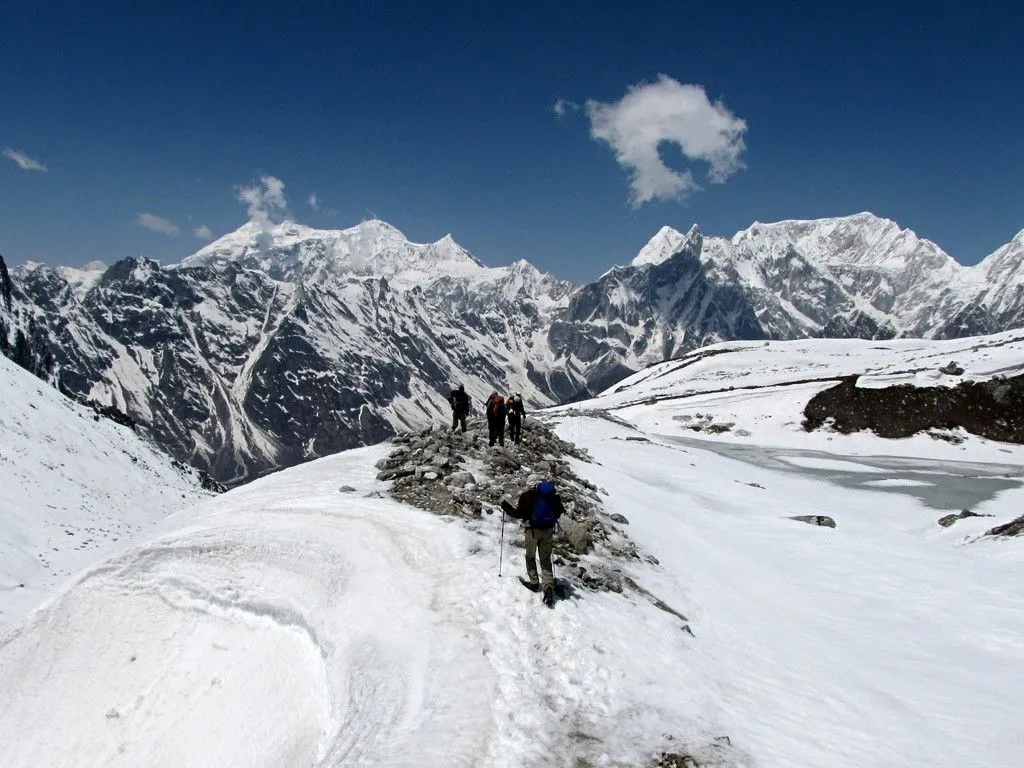
This is the day the whole trek has been building toward, and you'll want an early start. Breakfast comes before dawn, and you'll be on the trail while stars are still faintly visible. The route follows glacial moraine before dropping down to a small lake, then crosses a steep grassy slope to skirt the edge of the moraine down to four frozen lakes. From here, the final ascent to Larke La Pass begins. It's a hard climb, and the thin air at 5,213 meters makes every step feel deliberate. But reaching the top is one of those moments that genuinely takes your breath away, in every sense. Larkya Peak, Cheo Himal, Kang Guru, Himlung Himal, and Annapurna II all spread out before you in a single sweeping view. The descent is long, winding down through the moraines of Salpunda Glacier and eventually onto grassy terrain. The valley slowly widens as you walk, and after passing a large meadow and a mani wall, you reach Bhimtang. By the time you arrive, tired and euphoric in equal measure, you'll likely feel like the hardest part is behind you. Because it is.
After yesterday's effort, today feels like the trek is finally letting you breathe. The morning starts from behind a moraine wall and the trail heads downhill in a steady, manageable rhythm. You'll pass the Bhimtang Glacier and drop into the Budhi Gandaki Valley, with rhododendron forests filling the slopes around you. Karcher comes first, then the path follows the river down toward Gho. From Gho, you walk through open pastures and farmland before arriving at Tilje, a large and welcoming Gurung village. The final stretch carries you through Thonje Village, across the Dudh Khola and Marsyangdi Rivers, and into Dharapani (1,860 meters), where the day's walk comes to a pleasant close.
The boots go back in the bag today. After a relaxed breakfast in Dharapani, you'll board a vehicle and begin the long drive back toward civilization. The road follows the Marsyangdi River, passing through Himalayan towns like Bhulbule, Khudi, and Besisahar along the way. There's something a little bittersweet about watching the mountains shrink in the rear window. From Besisahar, the route rejoins the Prithvi Highway, running alongside the Marsyangdi and then the Trishuli River. It's a scenic drive all the way back to Kathmandu at an 1,400 meters, and by the time the city appears on the horizon, you'll have a full week of mountains, passes, and memories sitting comfortably in your legs.
See what past travelers are saying about their experience with Nepal Outdoor Expeditions.
Because your next adventure is impatiently waiting for you.
Last Minute Note: Grab incredible deals on the last minute departure / Book spontaneous trips to hip destinations with limited-time offers and discounted price
Not sure of your dates yet? Hold a departure with a 20% deposit. Cancel more than 60 days out and your deposit is refunded in full. Your first date change is free. If a departure doesn't reach minimum numbers, we'll offer you the nearest alternative date or a full refund, and we'll let you know at least 30 days out.
Before you think of or actually plan any adventurous or relaxing tours, travels, or treks with Nepal Outdoor Expeditions.
If you cancel more than 60 days before departure, we refund your deposit in full. Between 30 and 60 days, the 20% deposit is retained. Inside 30 days the trip cost is non-refundable, since by then we've already paid for your permits, flights, and teahouse bookings. Full detail on our booking page.
20% to reserve your place, with the balance due 60 days before departure. On this trek that's $193 to book and $772 two months before you fly. If you're booking within 7 days of departure, the full amount is due at booking.
Yes, as long as you let us know at least 30 days before your original departure date, your first change is free. Any change after that, or a change requested inside 30 days, is $200 per person.
10 Days Budget Manaslu Circuit Trek