Mount Everest isn’t just a mountain. It is one of the most extreme locations on the planet, with temperatures falling to temperatures below freezing, with oxygen being limited and storms being unpredictable.
The summit is almost 29,031.7 feet above sea level and appears to be a desolate, uninhabited place of ice and rock.
However, there is one thing, which shocks the majority: life does not entirely vanish on Everest. Most of us think that it is impossible to be alive in those harsh conditions. The reality, however, is more interesting than that.
Although it is true that the higher the altitude the lower the number of animals you will come across, Everest is not a deserted place. There are the various animals that have adapted to dwell at different levels on the mountain and formed their own different zones of existence.
As you climb Everest, you will find that the mountain is good at supporting various animals according to the altitude.
The forest valley is full of wild-life.
The rugged central parts are home to tough animals, and even close to the peak, some wonderful animals have contrived to live. The cast of characters in each zone is different, and each is specially designed to cope with the challenges of that height.
The knowledge of these zones makes us realize how strong nature can be, even in the most severe conditions of the world.
|
Altitude Zone |
Elevation Range | Animals Found |
| Lower Altitude | 2,800m to 4,000m | Red panda, Himalayan black bear, musk deer, Himalayan monal (danphe), langur monkeys |
| Mid Altitude | 4,000m to 5,500m | Himalayan tahr, blue sheep (bharal), snow leopard, yak, Himalayan marmot |
| High Altitude | Above 6000m |
Bar-headed goose, Himalayan jumping spider, yellow-billed chough |
Animals Found in the Everest Region by Altitude
Lower Altitudes (2,800m to 4,000m)
The first thing you see when you begin to climb Everest is that life is everywhere. These are the low slopes that are densely forested, green valleys, and cliffs of rock. The atmosphere is less strenuous to breathe, or it is not as frosty as it is at higher altitudes. This is the reason why numerous animals call this zone their home. It is nearly a new world from the bleak and icy mountains in the distance that you can see.
Red Panda
Think of an animal that is fluffy, cute, and as large as your house cat. That’s the red panda. You are likely to take one home as a pet in case you come across one since they are so adorable. However, these small creatures are wild animals that inhabit the bamboo forest above Everest.
Red pandas are night owls. They rest in the day in the trees and emerge only when it becomes dark. They also rise at night and hunt bamboo, insects, and, on rare occasions, small birds.
When chewing on and scampering around the forest, they end up dropping their seeds all over. This aids the growth of new plants; hence, these little animals are required in forests.
The issue lies in the fact that forests are deteriorating rapidly. Individuals are deforesting to construct houses and farms. Red pandas do not have any place to go without their bamboo homes.
The number of red pandas in the Everest region is decreasing yearly.
Himalayan Black Bear
Imagine now a big and strong bear with a great deal of black fur and a white spot upon its chest resembling a V-shaped lightning bolt. It is the Himalayan black bear, and it is one of the most impressive animals on the lower slopes of Everest.
Surprisingly, these bears are good climbers and swimmers. You would not have guessed such a big and heavy animal could climb trees, but they do it frequently to get food. They look through the forest to find fruits, nuts, and any more insects that they can consume.
They are in a sense the garbage disposal of the forest. They sweep away dead animals and fallen fruit, which would otherwise rot on the ground.

These bears attempt to avoid people most of the time. They are aware that we are dangerous and therefore remain in the forests. However, with the winter and lack of food, some bears become desperate and roam around villages in search of scraps.
It is at this stage that battles occur between bears and humans. Local inhabitants are at times forced to drive the bears away or guard against hunting of their animals.
Similar to red pandas, these bears are also victims when trees are destroyed. They require huge spaces to move and hunt; hence, when their houses are reduced, they find it difficult to sustain themselves.
Musk Deer
The musk deer is a strangely looking animal. It is small, less than half the size of a small dog, and the males possess these long, sharp teeth, which project out of their mouths. Well, it really looks humorous; nature seems to have done something wrong. These teeth are not used to fight but to be showcased to females and demonstrate their masculinity.
These are deer that are masters of the rocky land. They inhabit steep, rocky slopes on which normal animals would not be able to stand. But the musk deer spring round the rocks like springs. They are so good at jumping that they can hardly be caught by predators. Their size also enables them to penetrate in tight spaces where large hunters are unable to track them.
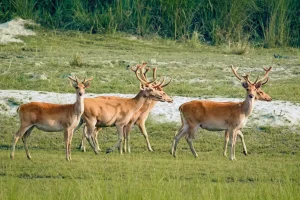
The most interesting fact about musk deer is that they have a strong-smelling scent that is discharged by a gland close to the tail.
To extract this scent, humans have been hunting musk deer ever since hundreds of years ago to use it in perfumes and medicines. Due to this hunting, musk deer are being wiped out at a rapid rate. It is one of the most tragic stories of wildlife in the Everest region.
These small deer feed on lichen and certain plants, which grow on rocks and trees. They are in most aspects non-violent animals struggling to make ends meet.
Their distinctive smell has, however, cost them the poaching victims. People are today striving to safeguard them and prevent illegal hunting, but it is a battle against time to ensure that they are not lost to extinction.
Himalayan Monal (Danphe)
One of the most beautiful birds you could ever see on Everest is the Himalayan Monal. The natives refer to it as Danphe, and it is the national bird of Nepal. When you happen to see one, you would know why people are so proud of it.
The males are brightly colored in a glittering paint that seems as though it were painted with all colors of the rainbow. Their plumes are glossy blues and greens and reds and golds, which appear to be glowing in the sun.
These are hardy birds that inhabit the rocky and forested slopes of lower Everest. They’re not like typical birds that stay hidden in trees. Rather, Himalayan monals roam on the ground, scratching and pecking the ground in search of food.
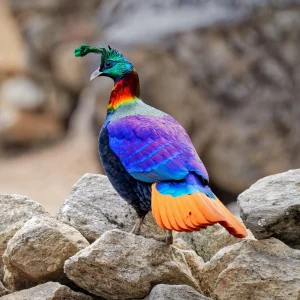
They consume insects, worms, tiny seeds, and roots of plants. You may hear their loud and peculiar callings rattling through the mountains in the daytime. It is a sound that people of the area are familiar with and enjoy listening to.
The only interesting thing about these birds is that they are faithful to their homes. After they settle on a place to reside, they will be there years together. They build their nests in rocky crevices or under thick bushes where predators can’t easily reach them.
The color of female monals is way less as compared to males. They are brown and dull-colored, which in fact makes them blend with their environment and be safe and guard their eggs.
Langur Monkeys
Langur monkeys are intelligent primates that have long tails and round faces, which make them appear almost human-like. They are social animals that exist in groups known as troops, and occasionally the groups consist of 10 or 30.
They are very social animals and need one another to survive, play with one another, groom each other to keep clean, and provide security to the young ones. In the case of the langurs, there is no bigger experience than observing a troop of them as a tight-knit family with everybody having a role and everybody being important.
The first sighting of langur monkeys was in the lower parts of Everest more than 30 years ago by the local herders and hunters who were familiar with the mountains. These observations have since been verified by visitors and the local communities that have witnessed numerous interactions with these amazing creatures ever since.
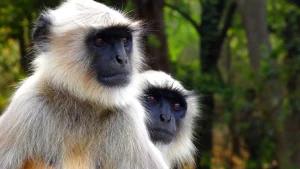
With time, individuals have got to know more about their behavior and how they live in the Everest region. These monkeys are still frequently observed in the woodland within the environs of the mountain today.
Young langur monkeys are roughly equal to a large house cat, and an average troop may consist of 10-30 individuals. Langurs are able to endure cold weather and tough conditions in the mountains, thanks to their thick fur that keeps them warm during harsh winters.
They also possess extremely powerful limbs and long tails that can enable them to jump long distances among trees, at times leaping as much as 50 feet up into the air. These adaptations render them fully adapted to live in the Everest forests.
Mid-Altitude (4,000m to 5,500m)
The higher up Mount Everest you go, the less air there is, and the temperature decreases drastically. The trees are very few and far between, and the landscape becomes rocky and barren. This is a cruel and mean zone, yet here some of the most difficult animals on the planet can be found. These animals have developed distinctive skills to endure where other animals cannot.
Himalayan Tahr
The Himalayan tahr is a wild goat that appears tough and rugged and is designed aptly to survive in mountainous cliffs. These are fat animals with shaggy fur that warms them during the freezing weather. The male is heavier and bigger in size than the female and may often be as heavy as a grown-up man.
They are curved and muscular in appearance, giving them the appearance that they were meant to live in the mountains.
Thousands of years have passed with Himalayan tahrs living on Everest slopes. They were first recorded several centuries ago by local herders and climbers in the stories that were handed down through generations.
Since this primitive period, mountaineers and the local communities have observed such animals repeatedly thousands of times. Tahrs are still commonly found today grazing on steep slopes and climbing steep cliffs, which most animals would fear.
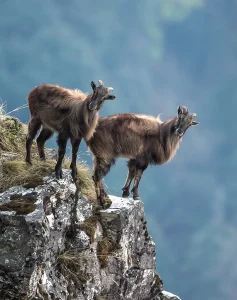
When born, the young Himalayan Tahrs are approximately the size of a medium-sized dog. Adult males have weights up to 100 pounds, and the female is smaller.
Tahrs are amazingly thick-finned to cope with the snow and freezing cold of the mid-altitude zones, with their winter coat-like fur. Their feet are specially crafted with rough pads that fit the rocks very well and enable them to climb even vertical rock without slipping.
This impressive skill can assist them in avoiding predators as well as locate food where other animals are unable to.
Blue Sheep (Bharal)
The Blue Sheep, also called the bharal, is one of the most unexpected animals that you will encounter in the mid-altitudes of Everest. It is not really blue, as the name suggests. Rather, it is greyish-blue in color, and this enables it to blend in seamlessly with the rocky terrain.
They resemble a combination of a sheep and a goat, and they are extremely strong mountain climbers that do not appear to follow the law of gravity.
Blue Sheep have been in the Everest region ever since time immemorial. The ancient hunters and mountain communities in the area have been studying and hunting these animals since time immemorial.
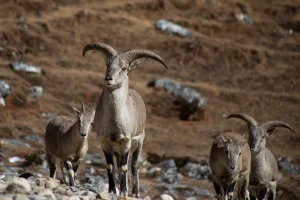
Climbers and researchers have seen Blue Sheep on rocky slopes of the mountain so frequently over the past several decades that such sightings are now the norm. Each visit confirms that these creatures are a valuable and a successful component of the Everest ecosystem.
Young Blue Sheep weighs about 40 to 50 pounds when fully grown. They dwell in large herds that may have hundreds of animals moving together over the rocky outcrops.
The Blue Sheep are adapted to endure the extreme low temperatures and thin air in the mid-altitude areas, which means they possess an amazingly thick wool that would serve as a winter blanket to them.
They have strong hind legs that help them jump and climb with such accuracy; they can leap through the rocks with the laws of physics not applying to them. These amazing powers cause them to be well adapted to their hazardous mountain house.
Snow Leopard
Snow Leopard is also referred to as an ounce and one of the most magnificent in Everest. Unluckily, these beautiful cats are about to die away. There are very few snow leopards, just some 6,000 in the whole world, and they are extremely rare and valuable.
These evasive snowcats are so timid and reclusive as to keep to themselves, living in remote areas of the wild and dense snow where humans seldom venture.
The initial sighting of snow leopards dates back to the early 1960s in the Everest area by the local Sherpa residing in villages beneath the base camp. Starting from that time, there have been many confirmed sightings by both visitors and native communities.
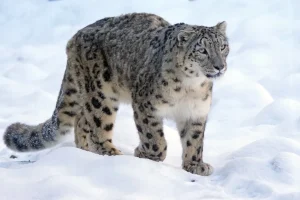
These incredible creatures have been observed by mountain climbers, researchers, and also local herders over decades. Every sighting is a special one since these animals are so hard to see in the wild.
When born, young snow leopards weigh a few pounds and are about the size of a big pet cat. On average, litters bear between 2 and 3 cubs. To endure the cold weather of the Himalayan mountains, snow leopards are thickly coated with a luxurious fur, which keeps them warm in the snowy weather.
Their huge paws act as natural snowshoes, which evenly distribute their weight on the snow to prevent sinking. These are powerful cats, good hunters, and very patient and accurate when it comes to stalking of Blue Sheep and other prey and, as such, are the master predators of the high mountains.
Yak (domestic & wild)
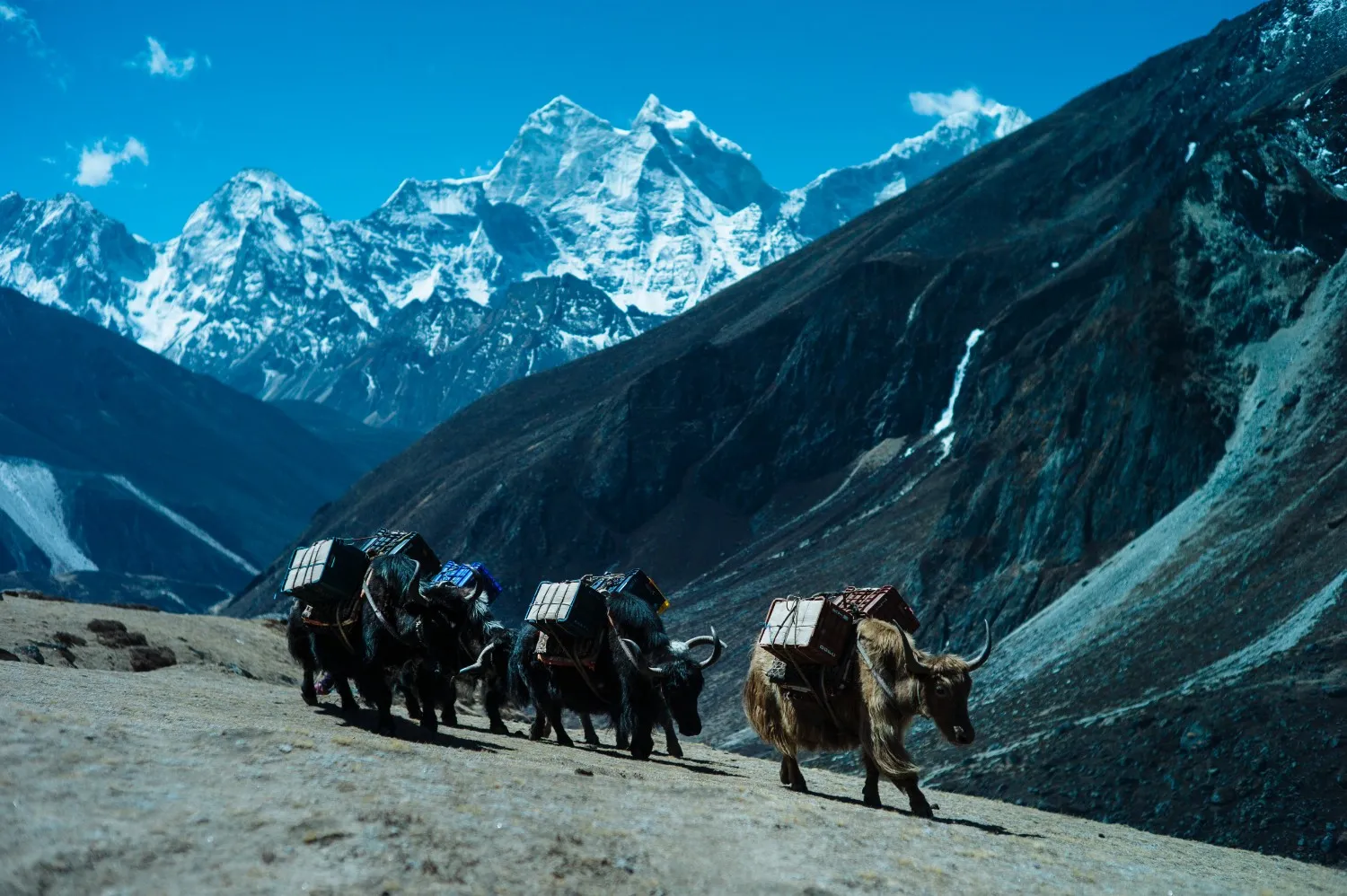
The yak is a shaggy and giant animal that has been in the Everest region for thousands of years. These great animals possess a good deal of long, thick hair, which is worn like a skirt and is down their backs, all the way around.
There are two kinds of yaks, domestic yaks and wild yaks, which are found roaming in the wilderness in the mountains. Both are extremely powerful and perfectly adapted to life at high altitudes.
Since ancient times, the Everest region has been recording the presence of yaks by local herders and mountain communities. History has indicated that these animals were used and seen by human beings thousands of years ago. In the recent few decades, trekkers and climbers have come across yaks innumerable times on the slopes of Everest.
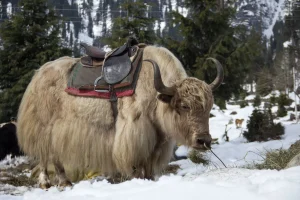
Nowadays, yaks still play a vital role in the lives of local Sherpa people, and they are still regularly seen around the area.
The young yaks are little and tough and, when fully grown, weigh about 100 to 150 pounds. They are herded animals that may move in dozens across the rocky landscape and grasses. Yaks have extremely thick fur, which keeps them fully covered against the harsh winds and freezing temperatures to survive in the extreme cold and thin air of high-altitude regions.
Their strong legs and well-constructed bodies allow them to transport heavy loads over mountainous routes. These supernatural powers render yaks indispensable to mountain climbers and local people who rely on them to get around and be able to survive.
Himalayan Marmot
The Himalayan marmot is a huge, fat rodent resembling a fat guinea pig or a squirrel on steroids. These are furry animals that are unexpectedly adorable and have short legs, making them stooped to the ground. Nevertheless, marmots are tough survivalists despite their small size; they can survive in the rough mid-altitude regions of Everest where not many other creatures can.
The Everest ecosystem has been home to Himalayan marmots since time immemorial. These animals have been observed since ancient times by local herders and mountain communities.
Climbers and researchers have as well recorded numerous experiences with marmots on the meadows and slopes of the mountain over the decades. Such common observations indicate that marmots are still a significant and flourishing component of the mid-altitude habitat.
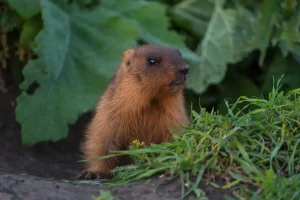
Mature young Himalayan marmots are barely 1 to 2 pounds and are therefore the smallest at mid-altitude. They cohabit in subsurface burrow complexes known as colonies and may have dozens of marmots living together. Marmots survive the freezing cold and thin air in the mountains by having dense fur, which perfectly insulates their bodies.
Their legs are short and powerful and enable them to dig burrows fast and evade danger. This is possible due to these adaptations enabling marmots to survive in one of the most hostile places on Earth, as they most of the time hibernate throughout the long and gruesome winters.
High-Altitude (Above 6,000m)
After 6,000 meters, you are in a place where there is hardly any life. The air is so thin that even with oxygen tanks, breathing becomes hard. The temperatures drop way below zero, and it is possible that the winds blow up to a point to knock them off their feet. But somehow there are some extraordinary creatures who have managed to make ends meet in this world that otherwise does not seem to have ways of surviving. These animals are some of the most extreme forms of nature.
Bar-Headed Goose
The bar-headed goose is a migratory bird that undertakes one of the greatest journeys ever on earth. The heads of these geese are marked with black and white striations, which are easily identifiable.
These fantastic birds are known to pass by Mount Everest every year on their migration between their breeding grounds in Central Asia and their wintering grounds in India. They are the only birds that habitually fly so high up in the air, and the air is perilously thin.
Bar-headed geese have been overflying Everest over millions of generations in what the local communities term their seasonal migration. According to stories transmitted by Sherpa families, these birds have been performing this fantastic voyage for thousands of years.
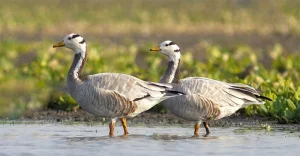
These geese have been observed by climbers climbing the mountain over the last few decades during periods of migration. Whenever these birds are spotted, it is a spectacular spectacle that stuns mountaineers into wonders of what nature can do.
When fully grown, the bar-headed geese weigh between 5 and 6 pounds and are therefore light enough to soar with amazing ease. They also fly in large flocks of hundreds or even thousands of birds flying in a big mass.
Bar-headed geese are adapted to survive the extreme cold and air of high altitudes that are low in oxygen by having special blood that enables them to use oxygen far better than other birds would.
Their strong wings enable them to fly to heights that most animals would just fall. These fantastic skills enable them to do one of the riskiest things in the animal kingdom, to cross the highest mountain in the world with perseverance and prowess.
Himalayan Jumping Spider
One of the tiniest and least expected creatures you can expect to come across at high altitudes on Everest is the Himalayan jumping spider. This small spider is hardly larger than your fingernail, but it is one of the hardiest animals that lives over 6,000 meters.
These small hunters possess huge frontal eyes, which make them appear to be almost intelligent and interested in what surrounds them.
The Himalayan jumping spiders have been living in the highest altitudes of Mount Everest over generations and generations. These small animals inhabiting the frozen mountainsides have been recorded by local climbers and scientists.
These spectacular spiders have been observed over the decades by mountaineers climbing up to the summit in areas where they appear to be the only creatures that can survive. These common occurrences affirm that jumping spiders are the toughest creatures at high altitudes.
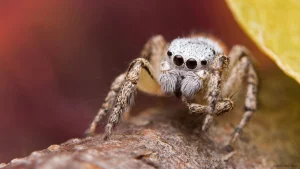
Young Himalayan Jumping Spiders are microscopic upon birth and are not much more than half an inch when mature. They are solitary hunters on the frozen ground, though so small. To endure the severe cold and harsh conditions at high altitudes, they possess special antifreeze-like proteins in their bodies that make them not freeze.
Their strong hind legs enable them to leap unbelievable distances in comparison to their body sizes, enabling them to seek insects and to avoid predators.
Jumping spiders are the masters of extreme altitudes with these amazing adaptations because they can survive at altitudes where almost all other life is utterly unable to survive.
Yellow-Billed Chough
The Yellow-Billed Chough is a very daring and clever bird; it takes its abode as high as possible on Everest. These are entirely black birds with the exception of their bright yellow beaks and legs, which stand out against the snow.
Yellow-billed choughs are scavengers that feed near climbers with the hope of finding food remnants abandoned on the mountain. Surprisingly they are not afraid, and they will approach human beings very closely, exhibiting near-zero fears.
The yellow-billed choughs have been making their livelihood in the highest elevations of Everest for so many generations.
These birds are familiar to locals of Sherpa communities since ancient times. Throughout the last few decades, a great number of climbers have reported their sightings of these spectacular birds at high altitudes.

Such sightings are so frequent that yellow-billed choughs have become archetypal of high-altitude mountaineering and their loathsome and inquisitive character.
When fully grown, young yellow-billed choughs are so light that they weigh only 5 or 7 ounces. They coexist in small groups called flocks, which go about in search of food in the frozen land.
To endure the cold and thin air at high altitudes, yellow-billed choughs are densely feathered, thus offering a good insulation layer. They have strong wings that enable them to fly easily in the thin air that can’t support other birds.
Their smarts and daring add to these adaptations and make them the most noticeable and easily remembered animals that climbers can see during their trip to the top of Everest.
How Animals Survive on Mount Everest
One of the most hostile locations on the Earth is Mount Everest. The further up you go, the colder things are. At the top, the weather would be approximately minus 40°C, and that is cold enough to freeze the skin (exposed ones) within several minutes.
The air is so sparse that it is hard to find sufficient oxygen to inhale. The mountain is constantly hit by powerful winds, and these winds are sometimes more than 200 kilometers per hour. Most animals would die in a few hours in such conditions.
But animals have discovered amazing methods of surviving in this fatal habitat. They have acquired, over thousands of years, special adaptations that enable them to live where none can.
Others have developed thick fur, which is a sort of winter coat, and their bodies are not cold in the harshest weather. Some have evolved special blood and lungs that enable them to get oxygen in the thin air at a much higher rate than the other animals do.
There are also some creatures who have adapted their metabolism or the way energy is processed in their bodies, resulting in lower oxygen consumption and retention of heat. This assists them to survive on minimal food and in bitter cold temperatures.
Several animals also seasonally migrate, going to lower altitudes when the conditions are too severe and coming back when the conditions are safer. These migration patterns have been inherited over the generations whereby animals know instinctively when and where to move.
The living creatures on Everest serve as living evidence that nature is extremely flexible. Every animal, the smallest jumping spider and the biggest yak, has worked out its own solutions to survive. These adaptations demonstrate to us how strong evolution can be and how life may exist even in the most extreme conditions of the world.
Threats to Animals on Mount Everest
Mount Everest’s animals are under severe threat that is increasingly becoming worse each year. Climate change is the greatest threat. Due to the increase in temperature globally, the snow and ice cover on Everest is melting at a rate that has never been experienced.
It implies that animals are deprived of their habitats and food supply. Perfectly adapted animals in extreme cold conditions fail to perform in the warmer weather, just a few degrees warmer.
Another big issue for the wildlife in Everest is tourism. The mountain is visited by thousands of climbers annually, and they cause noise, pollution, and disturbance to the habitats of animals. Climbers abandon trash and garbage that pollutes the environment.
The presence of humans all the time scares off some of the shy animals such as the snow leopards and causes them to leave their natural habitat. The paths left by climbers destroy vulnerable plants and soil on which animals rely to feed and provide shelter.
Development in the nearby areas is also a source of habitat disturbance. With the growth of villages and towns on the periphery of Everest, forests are deforested to make space to build.
Animals lose the areas to survive and to get food. Animal populations decrease when the habitat becomes smaller and smaller. Some of the species that previously prospered in the Everest region are finding it hard to survive due to the loss of their habitat.
Conservation Efforts in the Everest Region
Human beings are doing their best to save the animals of Mount Everest since they are aware that time is limited. A number of national parks and reserves have been established around the mountain to ensure the safety of wildlife. These are safe areas similar to those of a wildlife refuge where nature can heal without human intervention.
In such places, the tourists can visit only some of the trails, and development is highly restricted. Animals are finally given some peace and space to survive by preserving a few areas that are not to be disturbed by human activity. The rangers of the park also patrol these places to prevent poachers and illegal hunters who go and kill endangered species such as the snow leopard.
The true conservation heroes are the local community surrounding Everest. The Sherpas, along with other mountain families, have been coexisting with the animals of Everest since thousands of years ago.
They are familiar with the mountain more than anyone. Today, there are a large number of local individuals employed as guides, rangers, and conservation workers, and they are able to protect wildlife using their in-depth knowledge. They educate the visitors on how to appreciate nature and be considerate of the animals that are their home mates.
The Sherpa families are also transferring the values of conservation to their children to ensure that the new generation is concerned about the protection of the mountain and her animals.
Something magic happens when the local people and conservation organizations come together. Communities assist in maintaining a record of animals and report when they observe endangered species.
They are ready to replenish destroyed forests and grasslands and plant new trees and clean up polluted places. With the fusion of ancient knowledge gained by generations of mountain life and the new scientific knowledge, the Everest region is gradually turning out to be more habitable to wildlife.
Evidence that people can build a better world where animals and people can coexist side by side on the mountain is that people really do care and work together.
FAQs
1. Do any animals actually live on Mount Everest?
Yes, animals are found in the Everest region, but not all up at the very top. Lower and middle altitudes have more food and shelter, and this is where most wildlife can be found. Very few well-adapted species are able to live in the high-altitude extreme areas, such as some spiders and birds.
2. What is the most famous animal found on Mount Everest?
The most renowned animal in the Everest area is likely to be the snow leopard. It is famous because of its beauty and infrequent occurrence. These creatures are quite timid, and they merge well with rocky formations; that is why people can hardly observe these creatures.
3. Are there animals living at the top of Mount Everest?
No, not even the very top of Mount Everest is so extreme that animals can live there permanently. The absence of oxygen, low temperatures, and high winds are such that survival is virtually impossible. Nonetheless, not all birds are unable to fly above the peak, and microorganisms might manage to survive in the immediate surroundings.
4. Which animal lives at the highest altitude on Everest?
The Himalayan jumping spider is one of the highest living animals. It has been discovered in exceptionally high altitudes and preying on tiny insects swept by the wind. It demonstrates that even small organisms can be adapted to the unfriendly environment.
5. Can trekkers see wildlife during the Everest Base Camp trek?
Yes, wildlife is usually visible to trekkers, particularly at lower and mid altitudes. Common features are such animals as yaks, birds, and, in some cases, blue sheep. You may even see some of the more rare animals had you luck and silence, but these are rather uncommon.