
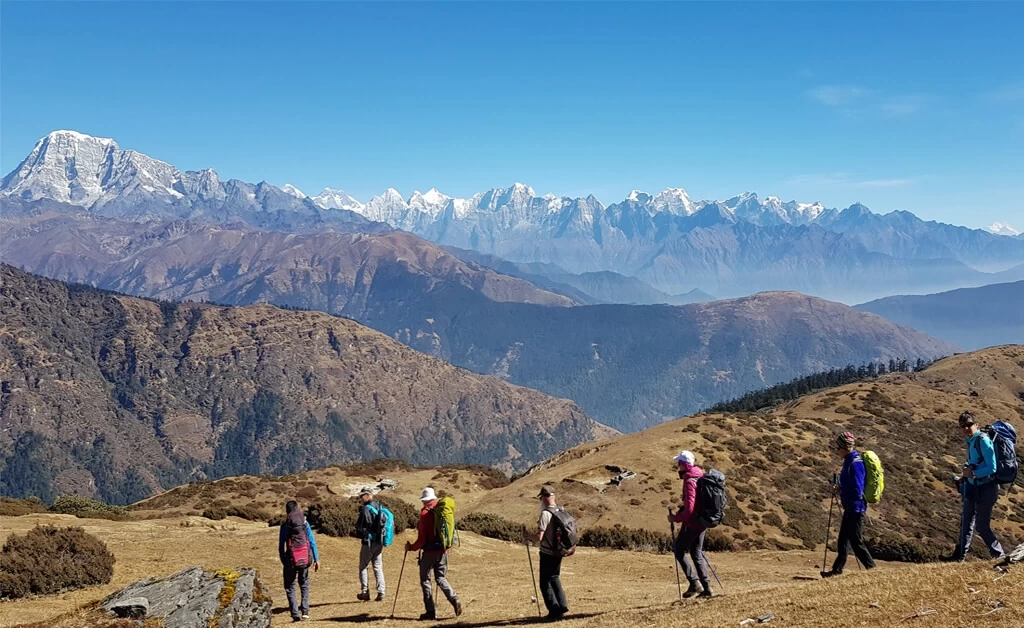
Nepal has dozens of trekking routes; however, seven stand out as the most famous: Everest Base Camp, Annapurna Circuit, Annapurna Base Camp, Langtang Valley, Mardi Himal, Ghorepani Poon Hill, and Gokyo Lakes. Each trek offers a unique experience, ranging from brief beginner-friendly hikes to demanding high-altitude expeditions above 5,000 meters. The right trek depends on 4 factors: how many days you have, your fitness level, your budget, and whether you’re drawn more to mountain views or Himalayan culture. We’ve guided trekkers on every route listed below, so this guide helps you choose the right trek, not just listing names.
The Quick Answer: Most Popular Treks in Nepal
| Trek | Duration | Difficulty | Maximum Altitude | Best For |
| Everest Base Camp | 12-14 days | Challenging | 5,364 m | Iconic mountain views |
| Annapurna Circuit | 12-18 days | Challenging | 5,416 m | Scenic and cultural variety |
| Annapurna Base Camp | 7-10 days | Moderate | 4,130 m | First-time high-altitude trekkers |
| Langtang Valley | 7-9 days | Moderate | 3,870 m | Short trek near Kathmandu |
| Mardi Himal | 5-7 days | Moderate | 4,500 m | Less crowded quick escape |
| Ghorepani Poon Hill | 4-6 days | Easy to Moderate | 3,210 m | Beginners and families |
| Gokyo Lakes | 12-14 days | Challenging | 5,357 m | Alternative to EBC, fewer crowds |
How to Choose the Right Trek in Nepal
Four factors determine which trek fits you: available time, fitness level, trekking enjoyment, and scenery choice. Compare these factors with the treks above, and the right choice becomes clear quickly.
Your available time is the biggest deciding factor. A 5-day window rules out Everest Three Passes but opens up Ghorepani Poon Hill or Mardi Himal. If you have 10 to 14 days, Everest Base Camp and Annapurna Base Camp each fit comfortably.
Fitness matters more than trekking experience for most routes. Daily walks of 5 to 7 hours on uneven terrain are common. Langtang Valley and Ghorepani Poon Hill require moderate fitness. Everest Three Passes needs robust cardiovascular conditioning and prior high-altitude exposure.
Experience shapes altitude tolerance and comfort with exposed trails. First-time trekkers do well on Annapurna Base Camp or Mardi Himal. Routes crossing passes above 5,000 meters, like Everest Three Passes or the Thorong La Pass on Annapurna Circuit, are for trekkers who’ve handled altitude before.
Scenery desire is personal. Everest region treks offer dramatic peaks like Kala Patthar’s Everest views. Annapurna routes mix mountain vistas with village lifestyle. Upper Mustang offers desolate canyon tracts and Tibetan Buddhist heritage in place of glaciers.
Many of our first-time trekkers expect the trek’s difficulty to be the biggest factor. It typically isn’t. Time and altitude tolerance determine better results than physical fitness does.
7 Most Popular Treks in Nepal

Everest Base Camp Trek
Everest Base Camp suits trekkers who want to stand at the foot of the world’s highest mountain and do not mind a demanding, high-altitude push to get there.
- Why it’s famous: The trail offers Everest, Lhotse, Nuptse, and Ama Dablam in a single journey, plus a stop at Kala Patthar, the best standpoint of Everest’s summit. Sherpa way of life alongside the way, in particular in Namche Bazaar and Tengboche, adds cultural depth to the experience.
- Trail experience: Suspension bridges over the Dudh Kosi, slow woodland-to-alpine transitions, and busy tea house villages define the stroll. Namche Bazaar breaks the trail with an acclimatization day.
- Duration: 12 to 14 days round-trip from Lukla.
- Difficulty: Challenging. Altitude, not terrain, is the primary obstacle. Daily walks run 5 to 6 hours.
- Best season: Late September to November, and March to May. Winter is possible but cold; monsoon months deliver poor visibility.
- Ideal for: Trekkers in good physical fitness who’ve completed at least one moderate trek earlier, and anyone prioritizing Everest views over solitude.
- Who shouldn’t choose it: Trekkers with fewer than 10 days available, or those uncomfortable with crowded tea houses during peak season. Choose Gokyo Lakes as an alternative in case you need comparable views with fewer people.

Annapurna Circuit Trek
Choose the Annapurna Circuit if you want the widest variety of landscapes and cultures in a single Nepal trek.
- Why it’s popular: The trail circles the Annapurna massif, crossing Thorong La Pass at 5,416 meters and passing through Manang and Muktinath. Few routes in Nepal change landscapes this dramatically, from rice terraces to arid Mustang-style terrain in days.
- Trail experience: Wide, well-set-up tea house trails run through Gurung and Thakali villages. Road construction has shortened parts of the original trail, so many trekkers now combine driving with walking on the lower sections.
- Duration: 12 to 18 days, depending on where you begin and whether you use jeep transfers on lower stretches.
- Difficulty: Challenging, mainly due to the Thorong La Pass crossing. The rest of the trail is moderate.
- Best season: March to May and September to November provide the clearest pass conditions. Winter closes Thorong La to most trekkers.
- Ideal for: Trekkers looking for cultural depth along mountain landscapes, and people who decide upon a longer, varied adventure over a single-destination trek.
- Who should not choose it: Trekkers short on time, or folks who dislike street sections combined with trail walking. Choose Annapurna Base Camp rather for a shorter, roadless opportunity.
Annapurna Base Camp Trek
Annapurna Base Camp suits trekkers who want an authentic high-altitude experience without committing to the time or altitude demands of Everest Base Camp.
- Why it’s popular: The trail ends within a natural amphitheater surrounded by Annapurna I, Machapuchare, and Hiunchuli, one of the most enclosed, dramatic viewpoints in Nepal. It’s shorter and more reachable than most Himalayan base camp treks.
- Trail experience: Stone-stepped trails wind through rhododendron forests, Gurung villages, and bamboo groves before starting into alpine terrain near base camp. The climb involves greater elevation gain and loss than the space suggests.
- Duration: 7 to 10 days.
- Difficulty: Moderate. No technical sections; however, each day’s walks include steep stone staircases that tire unprepared trekkers quickly.
- Best season: March to May for rhododendron blooms, and late September to November for clear mountain views.
- Ideal for: First-time high-altitude trekkers, and anyone looking for the most mountain views for a moderate time investment.
- Who shouldn’t pick out it: Trekkers in search of longer cultural immersion or true remoteness. Choose Annapurna Circuit instead for an extended, more varied route, or Mardi Himal for fewer crowds.
Langtang Valley Trek
Langtang Valley fits trekkers who need a real Himalayan trek without the long travel time that Everest and Annapurna routes require.
- Why it is famous: The trailhead sits just 7 to 8 hours from Kathmandu by road, no flight needed. The valley gives glacier views, Tamang tradition, and Langtang National Park’s forests, all inside a shorter window than most main treks.
- Trail experience: The trail follows the Langtang Khola upstream via woodland, then opens into a huge glacial valley. Kyanjin Gompa serves as the primary high point, with side hikes to Kyanjin Ri or Tserko Ri for closer mountain views.
- Duration: 7 to 9 days.
- Difficulty: Moderate. Terrain is possible, although sections rebuilt after the 2015 earthquake involve more trekking than the original trail.
- Best season: March to May and October to November. Winter treks are possible with the right equipment.
- Ideal for: Trekkers with limited travel time, and people looking for Himalayan landscapes without a domestic flight.
- Who shouldn’t choose it: Trekkers seeking the best peaks or longest remote wilderness. Choose Everest Base Camp or Manaslu Circuit as a substitute for bigger mountains and more distant terrain.

Mardi Himal Trek
Mardi Himal suits trekkers who need near-mountain views without the crowds found on Everest Base Camp or Annapurna Base Camp.
- Why it is famous: The trail offers near-up views of Machapuchare and the Annapurna range from a ridge that most other Annapurna region treks do not get access to. It remained relatively unknown until recent years, so trails and tea houses see far fewer trekkers.
- Trail experience: The trail climbs gradually via woodland and rhododendron before reaching an exposed ridge with panoramic views. The final stretch to High Camp is slender and ordinarily above the treeline.
- Duration: 5 to 7 days.
- Difficulty: Moderate. Shorter day-to-day distances than Annapurna Base Camp, but the ridge sections gain altitude quickly.
- Best season: March to May and late September to November. The ridge is exposed, so clean weather matters more here than on forested routes.
- Ideal for: Trekkers looking for a quick, less crowded Himalayan trek, and those combining trekking with other activities on a shorter Nepal trip.
- Who shouldn’t select it: Trekkers wanting a definitive base camp destination or longer cultural immersion. Choose Annapurna Base Camp rather for a more established route with village stays.
See our Mardi Himal Trek itinerary for route details.
Ghorepani Poon Hill Trek
Ghorepani Poon Hill suits first-time trekkers and families who want classic Himalayan views without high-altitude risk or long trekking days.
- Why it’s popular: Poon Hill’s sunrise viewpoint can provide panoramic views of Dhaulagiri, Annapurna South, and Machapuchare, one of the best view-to-effort ratios in Nepal. The short duration makes it ideal for trekkers with restricted travel time.
- Trail experience: Stone-stepped trails pass through rhododendron forests and Gurung and Magar villages like Ghandruk and Tadapani. The climb to Poon Hill itself, commonly before dawn, is the steepest push on the route.
- Duration: 4 to 6 days.
- Difficulty: Easy to moderate. No altitude worries above 3,210 meters, even though the stone staircases require constant leg strength.
- Best season: March to April for rhododendron blooms, and October to November for the clearest mountain views.
- Ideal for: Families, first-time trekkers, older trekkers, and everyone looking for mountain views on a limited schedule.
- Who should not pick it: Experienced trekkers wanting altitude challenge or extended wilderness. Choose Mardi Himal or Annapurna Base Camp rather for extra elevation and longer trail time.

Gokyo Lakes Trek
Gokyo Lakes fits trekkers who want Everest region views with fewer crowds than the usual Everest Base Camp trail.
- Why it is famous: The trail passes a series of turquoise glacial lakes and climbs Gokyo Ri, a viewpoint many trekkers consider above Kala Patthar for its wider panorama, along with four 8,000-meter peaks in a single frame. It additionally crosses the Ngozumpa Glacier, Nepal’s biggest.
- Trail experience: The trail follows a quieter valley west of the main Everest Base Camp route before the 2 trails reconnect near Namche Bazaar. Trekkers often integrate Gokyo with the Cho La Pass to link both valleys into one longer trail.
- Duration: 12 to 14 days.
- Difficulty: Challenging. Similar altitude demands to Everest Base Camp, with the added elevation gain of Gokyo Ri.
- Best season: Late September to November, and March to May, matching widespread Everest location timing.
- Ideal for: Trekkers who want Everest region scenery without the busiest trail, and people interested in glacial lake landscapes.
- Who should not select it: Trekkers looking for the precise Everest Base Camp itself, since Gokyo doesn’t attain it directly. Choose Everest Three Passes rather if you need both Gokyo and base camp in one journey.
Best Trek in Nepal by Category
Different priorities require different treks. Use this table when a specific need, not just popularity, is driving your decision.
| Category | Recommended Trek | Why |
| Best Overall | Everest Base Camp | Best balance of iconic views, infrastructure, and manageable difficulty |
| Best Beginner Trek | Ghorepani Poon Hill | Short duration, no altitude risk, well-developed tea houses |
| Best Short Trek | Mardi Himal | Big mountain views in just 5 to 7 days |
| Best Luxury Trek | Annapurna Base Camp | Wide range of upgraded lodges along an established route |
| Best Remote Trek | Gokyo Lakes | Quieter valley than the main Everest Base Camp trail |
| Best Family Trek | Ghorepani Poon Hill | Gentle pacing, shorter days, no extreme altitude |
| Best Photography Trek | Gokyo Lakes | Glacial lakes, Gokyo Ri panorama, and Ngozumpa Glacier in one route |
| Best Wildlife & Culture | Langtang Valley | Langtang National Park combined with Tamang village life |
| Best Challenge | Annapurna Circuit | Thorong La Pass at 5416 meters demands strong altitude tolerance |
| Least Crowded Trek | Mardi Himal | Lower trekker volume than any other Annapurna region route |
Best Time to Trek in Nepal
Nepal has four trekking seasons, each appropriate to exceptional routes.
Spring (March to May): the most popular trekking season, with mild temperatures and Rhododendrons bloom under 3,000 meters, and skies remain generally clear before pre-monsoon haze builds in late May. Best for Annapurna Base Camp, Ghorepani Poon Hill, and Everest Base Camp.
Summer (June to August): This is Nepal’s monsoon season. Rain, leeches, and cloud cover make most widespread routes impractical. Upper Mustang is the exception, because it sits in a rain shadow and remains dry and trekkable throughout monsoon.
Autumn (September to November): The clearest, most stable weather of the year, and the busiest trekking season. Mountain visibility peaks in October and November. Best for Everest Base Camp, Annapurna Circuit, Gokyo Lakes, and Everest Three Passes.
Winter (December to February): Cold at altitude, with some passes becoming impassable after heavy snowfall. Lower-altitude treks remain open and receive far fewer trekkers. Best for Ghorepani Poon Hill, Langtang Valley, and Mardi Himal, though pack for sub-zero nights above 3,500 meters.
If you are deciding between spring and autumn, we typically recommend autumn for first-time trekkers, due to the fact that visibility has a tendency to be more constant throughout the trek, not just in the mornings.
Trekking Permits Required
Permit requirements vary by region and route. Restricted regions require a licensed guide by law, not just by recommendation.
| Trek | Permit | Guide Required? | Restricted region? |
| Everest Base Camp | Sagarmatha National Park Permit + Khumbu Pasang Lhamu Rural Municipality Permit | Recommended | No |
| Annapurna Circuit | Annapurna Conservation Area Permit (ACAP) + TIMS Card | Recommended | No |
| Annapurna Base Camp | Annapurna Conservation Area Permit (ACAP) + TIMS Card | Recommended | No |
| Langtang Valley | Langtang National Park Permit + TIMS Card | Recommended | No |
| Mardi Himal | Annapurna Conservation Area Permit (ACAP) + TIMS Card | Recommended | No |
| Ghorepani Poon Hill | Annapurna Conservation Area Permit (ACAP) + TIMS Card | Recommended | No |
| Gokyo Lakes | Sagarmatha National Park Permit + Khumbu Pasang Lhamu Rural Municipality Permit | Recommended | No |
FAQs
Which is the most popular trek in Nepal?
Everest Base Camp is the most famous trek in Nepal, drawing more trekkers than any other route every year. Its combination of iconic mountain views, well-developed infrastructure, and Sherpa way of life makes it the default choice for first-time Himalayan trekkers.
What is the easiest trek in Nepal?
Ghorepani Poon Hill is the easiest popular trek in Nepal. It stays below 3,300 meters, involves no technical terrain, and takes just 4 to 6 days.
Which trek is best for beginners?
Ghorepani Poon Hill and Annapurna Base Camp fit beginners’ level. Both offer robust mountain views without demanding prior high-altitude experience.
Which trek has the best mountain views?
Gokyo Lakes and Everest Base Camp offer the best mountain views, with Gokyo Ri’s landscape displaying four 8,000-meter peaks in a single frame.
Which trek is less crowded?
Mardi Himal is the least crowded famous trek in Nepal, observed by way of Gokyo Lakes, which sees fewer trekkers than the standard Everest Base Camp trail.
Which trek is better: Everest Base Camp or Annapurna Circuit?
Everest Base Camp suits trekkers prioritizing iconic mountain views, even as Annapurna Circuit fits trekkers looking for more cultural and landscape range over a longer route.
Which trek is best in autumn?
Everest Base Camp and Annapurna Circuit are best in autumn, while mountain visibility peaks in October and November.
Do I need a guide for trekking in Nepal?
A guide isn’t legally required on most preferred routes; however, it is strongly encouraged. Restricted-region treks like Manaslu Circuit and Upper Mustang require a certified guide by means of law.
