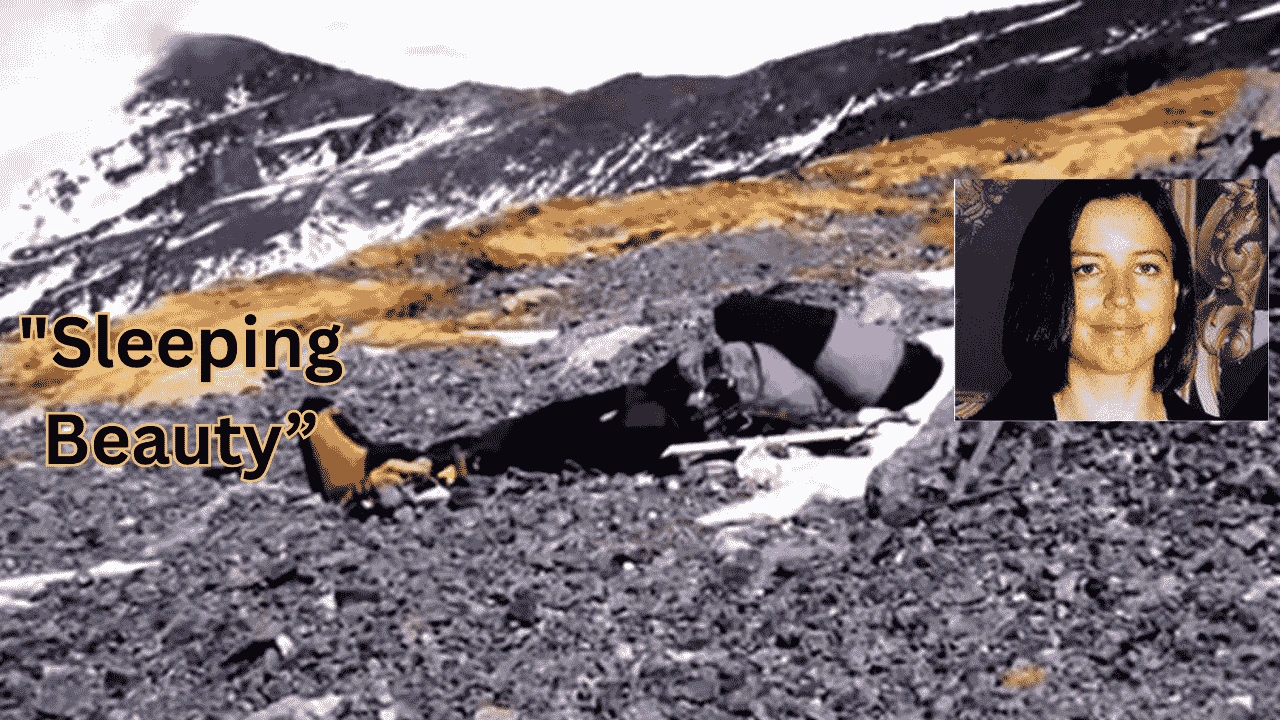
Everest’s Sleeping Beauty is Francys Arsentiev, an American climber who, in May 1998, was the first American female to summit Everest without supplemental oxygen. She fell seriously sick for the duration of her descent via the Death Zone and could not be rescued because of the acute situations above 8,000 meters. Her frame, preserved via the cold and found in a relaxed, restful posture at the slope, gave her the name that has stayed with the mountain ever since. Our companion piece on the Sleeping Beauty Everest identity goes deeper into who she was, and our guide to Green Boots Cave covers the other well-known landmark from the same stretch of the mountain.
Understanding the Name “Sleeping Beauty” on Everest
The nickname Sleeping Beauty formed naturally among those climbing Everest, where Francys Arsentiev’s body was found. Due to the extreme cold, her body remained preserved. She was discovered seated against the slope, eyes partially open. From a distance, she looked composed. Almost peaceful. More like she was resting than gone. The people who supported her climb deserve their own recognition too. Our guides to Everest porters, the wildlife found around Everest, and eco-friendly ways to trek from the USA cover different sides of this same mountain.
That stillness, paired with the emptiness of the Death Zone, created a strong emotional impact. It made the scene disturbing in a quiet way. The name itself was a human response to something unbearable. A way to cope with death in a place that offers no mercy.
On Everest, climbers name landmarks, routes, and even bodies. Naming matters. Oxygen deprivation affects memory, focus, and judgment. Clear reference points save time. And sometimes lives. In tragic cases, human remains become fixed markers, since snow and ice shift, but bodies often do not.
Naming also serves a psychological purpose. Facing death at extreme altitude is deeply unsettling. Giving something a name creates distance. Just enough to keep moving. To function. The name Sleeping Beauty was never meant to be disrespectful. It was quite sympathetic. Sadness. In a place where emotions, if left unchecked, can be just as dangerous as the mountain itself.
Who Was Francys Arsentiev?
Francys Arsentiev was a Hawaii-based American climber. She never chased fame. No big sponsors either. Yet she carved out a name in mountaineering through pure willpower. Quiet determination.
She had real experience at high altitude. Before Everest, she had already climbed several major peaks. This wasn’t a random dream. She knew what thin air does to the body. And the mind.
Francys was not a thrill-seeker. She understood mountaineering in depth, the physical punishment, the psychological toll. Friends and fellow climbers described her as focused, driven, and fiercely ambitious. Goal-oriented. She believed in pushing boundaries, not collecting applause. Fame wasn’t the point.
Climbing Everest was personal. Deeply so. Francys wanted to prove something to herself, more than to anyone else. Her goal was clear. Reach the summit of the highest mountain on Earth without supplemental oxygen.
At the time, this was considered one of the purest and most dangerous ways to climb Everest. Some compared it to running a marathon without water. Brutal. Relentless. Very few climbers had ever succeeded. Even fewer women.
Francys wanted to be the first American woman to summit Everest without bottled oxygen. That decision placed her among an elite group of climbers willing to accept extreme risk for a deeper sense of accomplishment. Not everyone understood it. She did.
The most critical and dangerous choice she made was rejecting oxygen. Several thousand meters above sea level, oxygen levels drop to nearly one-third of what the human body requires. Without supplemental oxygen, climbers face rapid exhaustion, dizziness, poor coordination, and serious risks like cerebral or pulmonary edema.
Elite climbers can sometimes manage this with perfect acclimatization and speed. Sometimes. But the margin for error is razor-thin. Francys knew the risks. She believed her preparation and mental strength would be enough. Everest doesn’t care. It never has.
Why Is She Called Everest’s Sleeping Beauty?
The nickname wasn’t given by means of journalists or filmmakers. It came from climbers themselves, the folks who exceeded her at the mountain and carried the photograph home with them.
When Francys was discovered on the slope, the intense bloodlessness had preserved her body. She appeared seated in opposition to the ice, eyes slightly open, her posture calm and composed. From a distance, she didn’t appear gone. She looked like someone who had definitely stopped to rest. That stillness, set towards the good-sized silence of the Death Zone, made the scene quietly devastating.
The name Sleeping Beauty was a human reaction to something insufferable. A way to maintain the photograph without breaking beneath it.
On Everest, naming matters is also practical. Oxygen deprivation influences memory and attention. Climbers use fixed reference factors to navigate and save time. Over the years, human remains at regular locations emerge as unintended landmarks, because snow and ice shift, our bodies often do not.
But the call carried greater than navigation. It carried grief. Everyone who used it understood what it stood for and what it cost her to come to be there.
It was by no means disrespectful. If something, it becomes the alternative. A quiet acknowledgment from individuals who knew better than anyone exactly how thin the line is between reaching the summit and never coming home.
Francys Arsentiev did not become a cautionary story on that mountain. She was a name on Everest, implying something.
The 1998 Everest Ascent: What Happened
In May 1998, Francys Arsentiev and her husband, Sergei Arsentiev, attempted to climb Everest from the north side in Tibet. No supplemental oxygen. Against overwhelming odds, Francys reached the summit. Her lifelong dream, achieved.
But she submitted very late in the day. Too late. She was already exhausted. Completely drained by altitude and effort. In high-altitude climbing, late summit times are dangerous. Descent requires more energy than ascent. And that’s where things often fall apart.
During the descent, Francys began to suffer severe physical and mental collapse. Her body could no longer function properly without oxygen. She became weak. Disoriented. Unable to move on her own.
Sergei descended ahead to retrieve an oxygen bottle and seek help. A desperate choice. In the Death Zone, climbers are forced into impossible decisions. Time disappears. Strength fades. Every move becomes life or death.
That separation proved fatal. Francys was left alone on the mountain. When other climbers encountered her the next day, she was still alive, but badly frostbitten and barely able to speak or move. Those who tried to help were already near collapse. There was no oxygen. No spare gear remained. Climbers also lacked the strength needed to carry another person at that altitude.
Rescue attempts failed. Despite real effort. Sergei later made one final attempt to reach her, climbing back up. He never returned. It is believed he died during the descent.
Also read: Trapped on the Roof of the World: The Untold Story of the 1996 Everest Disaster
Why Wasn’t She Rescued?
The question of why Francys Arsentiev was not saved is perhaps the most painful and most misunderstood part of her story. The answer lies mostly in the physical limits of the human body at extreme altitude. Above 8,000 meters, known as the Death Zone, oxygen is so scarce that even simple movement feels exhausting. Thinking slows. Coordination fails. Keeping warm becomes a fight.
At that height, carrying another adult human being is virtually impossible. It requires strength, oxygen, and time. All things climbers simply do not have. The men who encountered Francys were in terrible condition themselves. Gasping. Barely functioning. Trying to perform a full rescue would likely have resulted in multiple deaths.
From the outside, this is hard to accept. People often ask, from sea level, “Why didn’t they just bring her down?” But on Everest, physics and biology dictate ethical decisions, not intention. Moral responsibility collides with survival instinct at extreme altitude. Climbers who passed Francys did stop. They spoke to her. They tried to help in the limited ways they could. But they faced an impossible choice. Stay and die with her. Or descend and live.
This doesn’t erase the emotional weight of that decision. It only explains why rescue was not realistically possible.
Compared to other Everest rescues, Francys’s case tragically aligns with known patterns. Successful rescues above 8,000 meters are extremely rare. When they do occur, they require exceptional conditions. Multiple strong climbers. Supplemental oxygen. Fixed ropes. Immediate response. Most rescues happen below the Death Zone, where the body can still function with enough oxygen.
Francys was too high. Too weak. Too far along the route. Her situation became a brutal example of Everest’s reality. There are points where help simply cannot reach, even with the best intentions.
What Were Francys Arsentiev’s Last Words?
One of the most searched questions about Francys Arsentiev is: What were her last words? The answer is more complex than many articles suggest.
“Don’t leave me. Don’t leave me alone, please.”
The quote has become closely associated with her story and is extensively repeated across Everest articles and documentaries. According to climbers who encountered her while she was still alive on the north aspect of Everest, she was aware for a part of the time and asked not to be behind.
However, there is no verified historical record confirming that these are her actual last words. No one witnessed the exact moment of her dying, making it impossible to know what she said in her final moments.
What is certain is that multiple climbers found her significantly weakened, suffering from extreme exhaustion, hypothermia, and the effects of the extreme altitude. They tried to comfort and assess her, but rescuing her from above 8,000 meters became beyond what their physical condition allowed.
Whether those words were actually her final sentence or truly a few of the closing matters she said, they have become a heartbreaking symbol of one of Mount Everest’s most tragic stories.
The Psychological Impact on Climbers Who Passed By
For climbers who encountered Francys Arsentiev, the experience was psychologically devastating. Survivor’s guilt was common. The knowledge that they lived while she did not. The inability to save someone, even when it was physically impossible. These moments stayed with them.
Many replayed the encounter for years. Questioning themselves. Wondering what more they could have done. The guilt did not fade quickly. Sometimes it took decades.
Extreme altitude worsens trauma. Hypoxia affects memory, emotion, and perception. Climbers may feel confused, emotionally numb, or slow to react. The true emotional impact often hits only after descending to a lower altitude. Later, several climbers reported symptoms similar to post-traumatic stress. Nightmares. Anxiety. An inability to talk about the experience.
The silence of Everest amplifies this. Isolation leaves climbers alone with their thoughts. During the descent. And long after.
The impact went beyond individuals. It affected the mountaineering community as a whole. Francys’s story forced climbers to confront uncomfortable truths. The limits of heroism. The cost of ambition. The psychological toll of survival. Some became more cautious. Others rethought safety and ethics. A few walked away from high-altitude climbing entirely.
Her story didn’t end on the mountain. It continued in the minds of those who passed her, shaping how Everest is viewed even today.
Media Coverage, Myths, and Misunderstandings
Francys Arsentiev’s story spread globally through climbers’ accounts, books, documentaries, and later the internet. It became one of Everest’s most discussed tragedies. Early reports came from mountaineers who had encountered her and later shared their experiences. As Everest gained mainstream attention in the late 1990s and early 2000s, her story was retold again and again.
With repetition came simplification. Complex events were flattened into dramatic headlines. A deeply human tragedy slowly turned into a cautionary tale for mass audiences.
The most common misconception is that climbers ignored her or were blinded by ambition. It’s emotionally compelling. But misleading. Some climbers did stop. They talked to her. They did what little they could. Their physical limits made anything more impossible.
Another myth is that Everest climbers are desensitized to death. First-hand accounts show the opposite. Many were deeply shaken and haunted. Hypoxia, exhaustion, and extreme cold are rarely visible in media portrayals. Decisions made at 8,000 meters are often judged by sea-level logic. That disconnect fuels misunderstanding.
Separating fact from narrative is essential. The facts are clear. Francys reached the summit. She became incapacitated during descent. She could not be saved due to extreme physical limits in the Death Zone. The story layered on top often seeks blame or a villain. Reality offers none.
This is not a story of neglect. It is a story of human limits.
The 2007 Recovery Mission: Restoring Dignity
Nearly ten years after her death, Francys Arsentiev’s body remained visible along the climbing route. For many climbers, this became deeply disturbing. It raised ethical concerns. Leaving her exposed felt wrong. A violation of basic dignity.
In 2007, a small expedition led by experienced climbers, including Ian Woodall, made a deliberate effort to address this. Woodall had encountered Francys alive in 1998. This was not a traditional recovery. Bringing a body down from that altitude is nearly impossible.
Instead, her remains were moved off the main route and relocated to a more sheltered location. Covered. Out of sight. This reduced repeated encounters and prevented her from becoming a spectacle. The work was dangerous. Physically exhausting. Done in severe conditions. And done purely out of respect.
The purpose was simple. Restore dignity.
It also offered some closure to climbers who had carried the emotional weight of leaving her there. The decision reflected a broader shift in Everest’s ethics toward responsibility, humanity, respect, not just conquest.
The tragedy could not be undone. But the 2007 mission marked a moment of recognition. Everest is not only about summits. Sometimes, it’s about how we treat life and death.
What International Trekkers Can Learn from This Story
The case of Francys Arsentiev is a powerful lesson not just for climbers but also for international trekkers visiting the Himalayas. Even though trekking paths are far below Everest’s Death Zone, altitude still stresses the human body.
Many trekkers don’t realize how fast energy, judgment, and coordination can fall apart with rising altitude. Francys’s story proves one thing: mountains are not conquered by ambition alone. They demand patience, humility, and respect. Even the strongest, most experienced people can become exhausted when extreme altitude and fatigue kick in.
Preparation is essential. But it has limits. Physical conditioning, good gear, and prior experience all help, but no guarantee that your body won’t suffer from altitude sickness or abnormal fatigue. Francys was ready, determined, and willing, and yet, nothing could overcome the biological effects of oxygen deprivation.
For trekkers, this means one thing: sometimes turning back is the wisest choice. The mountains will always be there. Life won’t. Following rules, listening to guides, observing acclimatization schedules, noticing early warning signs—these aren’t weaknesses. They are wisdom.
The story also teaches ethical awareness in the Himalayas. Trekkers pass through isolated villages. Fragile ecosystems. Encounter fellow travelers in tricky situations. Understanding limits of help. Respecting local knowledge. Not judging hard choices.
These are all part of responsible traveling. Francys’s story reminds us that empathy is as important as adventure. All mountain expeditions carry human costs. Sometimes invisible, sometimes devastating.
The main lessons for international trekkers are:
-
Respect altitude’s effects.
-
Recognize physical and mental limits.
-
Prioritize proper acclimatization.
-
Know when to turn back.
-
Trust experienced guides and local knowledge.
-
Maintain ethical awareness and empathy.
-
Understand safety matters more than achievements or destinations.
Beyond the Story of “Sleeping Beauty”
Francys Arsentiev’s story shows the delicate balance between ambition and nature. Everest doesn’t care about intentions, experience, or dreams. It only tests your body against reality.
Her determination proves the power of the human spirit. But her fate teaches a hard truth: ambition alone cannot overcome height, oxygen loss, and exhaustion. Success and tragedy are separated by the narrowest margins. On top of the world, courage is not enough. Nature sets the final rules.
Mount Everest demands humility from everyone. Preparation only goes so far. Decisions must stay flexible. Turning back isn’t failure. It is wisdom. For the global trekking community, the lesson is clear: be careful. Protect your body. Cherish life over glory.
The Himalayas offer more than adventure. They offer insight. Lasting lessons. Profound wisdom—if approached with awareness, humility, and empathy.
Related article: Rainbow Valley: Everest’s Frozen Zone
FAQs
1. Has the story of “Sleeping Beauty” changed modern Everest regulations or policies?
No single tragedy rewrote the Everest rules. But Francys Arsentiev’s case influenced stricter regulations. Summit cut-off times are now enforced. Guides are more accountable. Turnaround decisions carry greater emphasis. Most expedition operators now have non-negotiable descent policies, even close to the summit.
2. Are bodies still visible on Everest today, or has the situation changed?
Not all bodies are gone. But far fewer are visible along major paths than before. Cleanup efforts, ethics campaigns, and route changes helped. Full removal remains hazardous. Often, it’s simply impossible.
3. Why do some climbers choose to climb Everest without supplemental oxygen despite the risks?
It’s considered the purest form of mountaineering. Climbers do it to test themselves, leave a legacy, or push human limits. Risk is extreme. It’s not recommended for most climbers.
4. How did Francys Arsentiev’s story influence public perception of Everest tourism?
Her story shifted Everest from bucket-list adventure to real danger. Ethical issues came into focus. Unchecked ambition has consequences. The story also highlights differences between trekking culture and high-altitude mountaineering.
5. Is Everest safer today than it was in the 1990s?
Yes. The equipment is better. Communication and rescue coordination have advanced. But the risks of altitude remain. Overcrowding, commercialization, and human limits mean Everest is, and always will be, a dangerous mountain. What Is the Story of Everest’s “Sleeping Beauty”?
7. Did Francys Arsentiev really say “Don’t leave me alone”?
The quote is widely attributed to Francys Arsentiev and has appeared in many retellings of her story. However, there’s no official record confirming these have been her precise very last phrases. They are based on accounts from climbers who encountered her while she was still alive, not from the moment of her demise.