Sleeping Beauty on Everest was Francys Arsentiev, an American climber who died within the Death Zone during her descent from the summit in May 1998. She had just emerged as the first American lady to reach the summit of Mount Everest without supplemental oxygen, a feat that only a handful of climbers had carried out at that point.
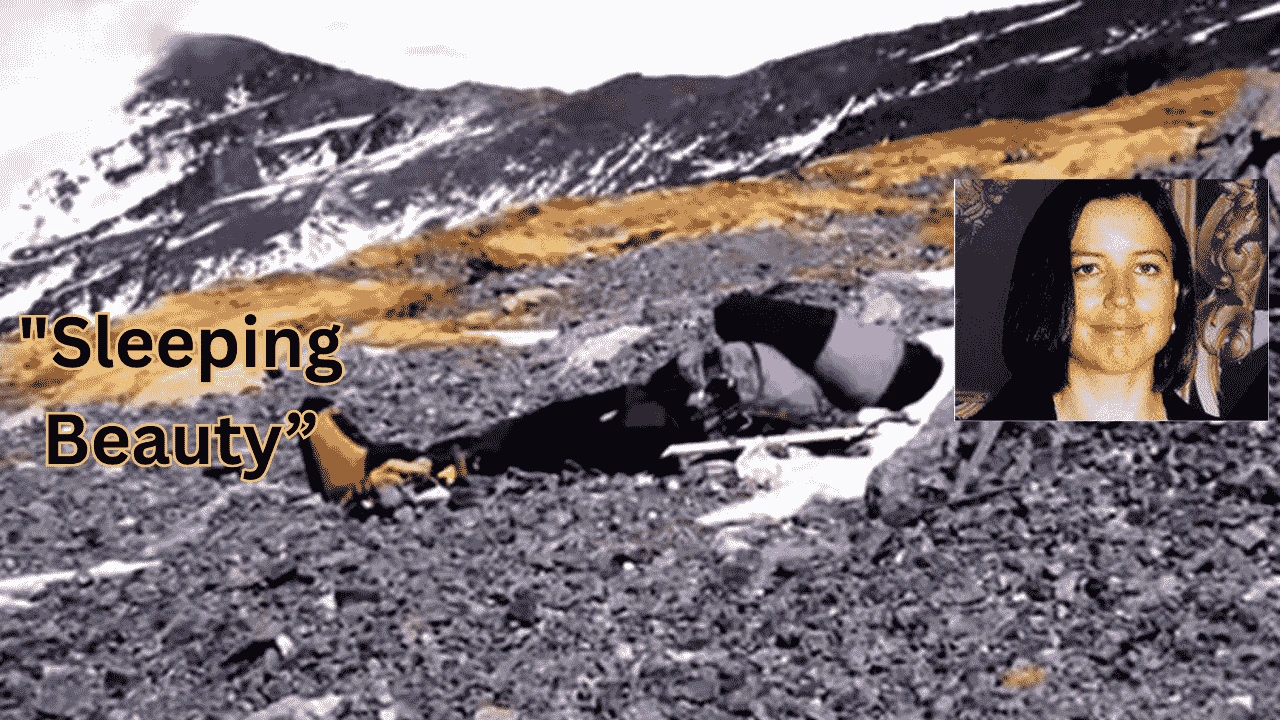
Climbers gave her the nickname “Sleeping Beauty” after her body came to rest beside the Northeast Ridge course, placed in a manner that appeared peaceful as opposed to tragic. Her story is one of the most mentioned in Everest history, not due to how she died, but due to what her story revealed about the limits of high-altitude rescue and the brutal calculus climbers face above 8,000 meters.
This article separates the validated understanding of Francys Arsentiev’s expedition from the myths that have spread online. It covers her climbing career, the 1998 expedition, the rescue attempts, what occurred to her husband, Sergei Arsentiev, and where her body rests these days.
Who Was Sleeping Beauty on Mount Everest?
Sleeping Beauty was Francys Arsentiev, an American mountaineer who died during her descent from Mount Everest in 1998. Climbers later gave her this nickname because her body rested beside the Northeast Ridge climbing route, appearing as though she had been asleep rather than deceased.
Francys Arsentiev was born in Texas and grew up with a strong interest in the outdoors. She worked as a flight attendant, a job that gave her the ability to travel and pursue mountain climbing across several continents. By the time she tried Everest, she had already built a strong climbing resume on other major peaks.
She married Sergei Arsentiev, a Russian mountaineer known for his extreme-altitude experience and his own no-oxygen ascents. Their relationship was based on a shared passion for mountain climbing without artificial aids, a style that purists within the mountain climbing community consider the truest test of strength and persistence.
Francys and Sergei set their sights on Everest with one specific ambition: to summit collectively without bottled oxygen. This purpose placed them amongst a small group of climbers willing to accept the extreme physical threat that includes skipping supplemental oxygen above 8,000 meters, an altitude range mountaineers call the Death Zone, because the human body cannot acclimatize there long-term.
Her identity as a skilled, driven climber, not just as a tragic Everest landmark, provides the context for understanding what happened in 1998.
Who Was Francys Arsentiev?
Francys Arsentiev built her mountain climbing career regularly, hiking peaks throughout America, South America, and Asia before she ever considered Everest. Her early ascents included technical routes that demanded both physical conditioning and cold-weather expedition experience, abilities she carried at once into her Himalayan expeditions.
She met Sergei Arsentiev through the international mountain climbing circuit, where his reputation as a robust, high-altitude climber was already established. Sergei had summited peaks above 7,000 meters without oxygen more than once, and his technique for mountaineering shaped how the couple planned their expeditions together. They climbed as companions, no longer just spouses, trusting each other’s judgment in situations where a single wrong decision may be deadly.
Before Everest, the couple had already tried the mountain as early as 1996; however, they turned back due to weather and logistical setbacks. That failed try only strengthened their resolve. They spent the subsequent two years preparing mainly for a second try, this time targeting a no-oxygen summit from the North side in Tibet.
Their shared dream was not simply to reach the summit. It was accomplished collectively, without bottled oxygen, in a fashion that reflected natural mountaineering rather than assisted climbing. This difference matters because it explains why Francys pushed forward when the situation on summit day grew more and more dangerous. For more on Sergei’s personal hiking history and his very last choices on the mountain, read Francys Arsentiev’s Husband Sergei Arsentiev on Everest: The Complete Story.
The 1998 Everest Expedition
Francys and Sergei Arsentiev returned to Mount Everest in the spring of 1998, this time coming from the Tibetan side in preference to the usual Nepal route. The North Side route follows the Northeast Ridge, an extended and more exposed line than the South Col course most industrial expeditions use nowadays. Climbers thinking about this technique nowadays can compare conditions in Everest North Side vs South Side Weather: Which Route Has Better Climbing Conditions?
The couple spent weeks acclimatizing through a series of rotations between base camp and better camps, a standard procedure that allowed their bodies to adjust gradually to reduce oxygen levels earlier than a summit push. The weather on the North side that season was unpredictable, forcing the crew to modify their timeline more than once.
Sergei and Francys made a deliberate selection to climb without supplemental oxygen, a preference that very few climbers tried correctly in the late 1990s. Bottled oxygen reduces the physiological strain of excessive altitude significantly, so mountain climbing without it multiplies the hazard of exhaustion, impaired judgment, and slower response times at some point of the descent.
By mid-May 1998, the group judged conditions favorable enough for a summit attempt. Francys and Sergei started their push towards the top, completely conscious that a no-oxygen ascent from the North side might test their limits more seriously than any climb they had attempted before.
Did Francys Arsentiev Reach the Summit?
Yes, Francys Arsentiev reached the summit of Mount Everest on May 22, 1998. Her ascent made her the first American girl to summit Everest without supplemental oxygen, a feat that still holds historic significance in mountaineering circles these days.
This success positioned her among an exclusive group of climbers. In 1998, a small number of people worldwide had summited Everest without bottled oxygen, and even fewer were women. The physiological demands of mountaineering above eight,000 meters without supplemental air are excessive: decreased oxygen saturation slows cognitive function, drains energy reserves more quickly, and leaves less margin for mistakes at some point of the descent.
Sergei summited separately from Francys because of the tempo variations that increase throughout long no-oxygen climbs. Extreme fatigue and the physical toll of the ascent meant the couple had become separated on the mountain, an element that would become crucial to knowing what happened subsequently.
Francis’s summit success was actual and historic. What was observed on the descent, however, became one of the most studied cautionary tales in Everest history.
What Happened During the Descent?
Descending from the summit proved far more dangerous for Francys Arsentiev than the climb up. Exhaustion from the no-oxygen ascent had already depleted her energy, and the results of prolonged exposure to severe altitude started to compound with each step downward.
Francys and Sergei became separated during the descent, each shifting at a distinct tempo as fatigue set in. This separation is not unusual on no-oxygen climbs, where partners frequently can’t maintain the same pace once oxygen deprivation begins affecting muscle function and decision-making.
Somewhere on the descent, Francys reached a point at which she could no longer move beneath her personal energy. Oxygen deprivation at that altitude impacts the brain immediately, inflicting confusion, loss of coordination, and, sooner or later, the inability to manipulate fundamental mobility. Worsening climate conditions on the mountain that night brought another layer of danger, reducing visibility and lowering temperatures further.
Descending is statistically riskier than ascending on Everest for an easy reason: climbers are more depleted, extra oxygen-starved, and more susceptible to critical errors precisely while the terrain nevertheless demands complete attention. Francys’s situation demonstrated this reality exactly. She had used everything she had to attain the summit, and the descent asked for reserves her body no longer had.
The Rescue Attempts
Climbers who encountered Francys Arsentiev on the mountain found her alive, however, unable to move due to her personal strength. Ian Woodall and Cathy O’Dowd, part of a South African expedition crew, were among the people who reached her during their own summit attempt and made the difficult choice to try to assist.
At the altitude where Francys was lying, close to 8,500 meters, rescue becomes a completely different undertaking than at lower camps. The Death Zone offers no margin for prolonged physical effort. Rescuers themselves face rapidly depleting oxygen, dropping body temperature, and the equal cognitive decline that had already incapacitated Francys.
Woodall and O’Dowd tried to move her; her weight mixed with the terrain and their personal deteriorating circumstances made a physical carry-down not possible. No helicopter rescue exists at that altitude either; Everest’s upper slopes sit far beyond the operational ceiling of any rescue aircraft.
Other climbers passing by that day confronted the same impossible choice: continue their own summit attempt even as critically low on oxygen and time, or stay and risk not being able to descend themselves. This is not a judgment on any character’s choice. It displays the physical fact of the Death Zone, in which survival math frequently overrides intention, irrespective of how robust the need to help is.
What Happened to Sergei Arsentiev?
Sergei Arsentiev returned for Francys as soon as he found out she was in trouble, mountain climbing again up into the Death Zone in an attempt to rescue and help his wife. This decision was intended to re-enter one of the most oxygen-deprived, physically punishing environments on Earth, already exhausted from his personal summit push.
Sergei disappeared during this rescue attempt. Search efforts and later accounts from climbers at the mountain that season pieced together that he had fallen, possibly even as looking to navigate the terrain lower back towards Francys in deteriorating conditions. His body was discovered later, breaking free, while Francys remained.
Sergei’s final decision reflects a defining detail of his story: he chose to go back for his wife instead of preserving his own descent to safety. Mountaineering historians and climbers who have studied the 1998 expedition frequently point to this preference as one of the clearest examples of the not possible change-offs the Death Zone forces on climbers, in which supporting another person can cost a rescuer their very own existence.
For a complete account of Sergei’s mountain climbing history, his final hours on the mountain, and the way his story intersects with Francys’s, read Francys Arsentiev’s Husband Sergei Arsentiev on Everest: The Complete Story.
Why Was She Called “Sleeping Beauty”?
Climbers gave Francys Arsentiev the nickname “Sleeping Beauty” because of how peaceful her body seemed after she died. She sported a crimson mountain climbing jacket, and her very last role beside the fixed ropes on the Northeast Ridge made it appear as though she had been resting instead of deceased.
This nickname was never professional. No expedition group, mountaineering business enterprise, or news outlet assigned it formally. It emerged informally amongst climbers who passed her location on the course in the years following 1998, and it stuck because it captured the unsettling contrast between her serene look and the tragedy of the way she died.
Her position beside the mountain climbing course meant that for years, mountaineers ascending or descending the Northeast Ridge noticed her directly. This visibility is part of why her story spread so extensively, unlike many other Everest deaths in which the body stays hidden from the primary course entirely.
It’s worth being specific here: the nickname describes her appearance, no longer her identity or her achievements. Francys Arsentiev was an accomplished climber first. “Sleeping Beauty” is, in reality, the name climbers used to refer to what they encountered at the mountain. For the full account of the way this story has been told and retold over time, see Everest’s Sleeping Beauty: The True Story of Francys Arsentiev.
Where Was Sleeping Beauty on Everest?
Francys Arsentiev’s body rested on the Northeast Ridge, on the Tibetan side of Mount Everest, at an altitude of about 8,500 meters. This location places her at once in the Death Zone, the elevation band above 8,000 meters where oxygen levels are too low to sustain human lifestyles for extended intervals.
The Northeast Ridge is the number one route climbers use when summiting from Tibet, which means her position sat directly alongside the route that lots of climbers might take in the years following her death. Unlike bodies located off the principal path, hers remained in clean view of anyone moving along that phase of the ridge.
This visibility explains why so many climbers, in my opinion, encountered her over nearly a decade. She wasn’t a story passed down secondhand; She became an unintended landmark that climbers passed on their way to and from the summit, making her story deeply personal for many who climbed the Northeast Ridge. Climbers studying the North side route in extra detail can locate route and climate specifics in the Everest North Side vs South Side. Weather: Which Route Has Better Climbing Conditions?
Was Sleeping Beauty Ever Removed?
No, Francys Arsentiev’s body was never recovered from Mount Everest. In 2007, Ian Woodall, one of the climbers who had attempted to assist her in 1998, returned to the mountain, particularly to relocate her body away from the primary climbing path.
Woodall moved her from her original position beside the fixed ropes to a more private place, out of direct view of climbers ascending or descending the Northeast Ridge. He also wrapped her body in an American flag as a gesture of appreciation, marking a quiet, deliberate act as opposed to a complete recovery operation.
It’s important to be specific about what this relocation definitely means. Removing a body from Everest’s higher slopes and carrying it right down to lower elevations is a noticeably hard, risky, and luxurious task, one that has been attempted a handful of times in Everest’s history. Woodall’s 2007 return did not involve bringing her down the mountain. It involved transferring her a short distance from the uncovered climbing route to a resting area shielded from public view.
This difference in importance is because online accounts often blur the distinction between “moved” and “recovered.” Francys Arsentiev remains on Everest today, now not seen by passing climbers, but has not returned to the lower floor.
Why Is Francys Arsentiev’s Story Still Remembered?
Francys Arsentiev’s story endures because it captures the overall weight of what mountaineering ethics seem like when tested in actual time, not in theory. Her death compelled the hiking community to confront difficult questions about when a rescue attempt becomes too risky to continue, and who bears responsibility for that decision.
Her case remains one of the clearest illustrations of the limits of rescue above 8,000 meters. No amount of skill, gadget, or self-control completely overcomes the physiological reality of the Death Zone, where rescuers face equally life-threatening situations because of the character they’re seeking to keep.
Francys’s achievement, summiting without supplemental oxygen because the first American lady to do so, also continuing her story applicable for reasons beyond tragedy. Her climb represents true human staying power and technical skill, performed through years of planned education with Sergei.
Mountaineering historians often refer to the 1998 expedition in particular, as it happened throughout a pivotal generation, right as industrial Everest expeditions were becoming more commonplace and the number of visitors was increasing. Her story sits at the intersection of personal ambition, partnership, and the unforgiving math of high-altitude survival, which is why it stays part of the wider historic record of Everest in place of fading as a remote incident.
What Her Story Teaches Climbers
Francys Arsentiev’s expedition offers concrete lessons that contemporary climbers and expedition operators still follow today. The most direct one centers on turnaround times: setting a strict time by which climbers must start descending, no matter how close they’re to the summit, and sticking to it even when the goal feels within reach.
Her story additionally reinforces a principle experienced courses repeat continuously: the summit is only halfway. Climbers must save enough energy to descend safely after reaching the summit, but no-oxygen climbs leave them with almost no margin for error.
Altitude outcomes on judgment are another key takeaway. Oxygen deprivation impairs decision-making well before it becomes physically apparent, which means that climbers need pre-agreed protocols and turnaround guidelines in place of counting on split-second judgment at high altitude.
Partner communication and contingency planning matter just as a great deal more. Francys and Sergei’s separation at some point during the descent shows why mountain climbing groups need clean plans for what happens if participants get separated, including how and when to try to find help.
Modern expeditions build on those lessons directly. Trekkers and climbers preparing for their own Everest region trek can see how these protection ideas follow on a properly supported route through the Everest Base Camp Trek.
FAQs
Who was Sleeping Beauty on Everest?
Sleeping Beauty was Francys Arsentiev, an American mountaineer who died during her descent from Mount Everest in May 1998, rapidly after turning into the first American lady to summit without supplemental oxygen.
Why is Francys Arsentiev called Sleeping Beauty?
Climbers gave her this casual nickname because her body, wearing a purple jacket, rested beside the Northeast Ridge route in a position that seemed peaceful, as though she had been asleep.
Did Francys Arsentiev reach the summit?
Yes. She reached the summit on May 22, 1998, reaching her intention of hiking Everest without bottled oxygen.
Was Francys Arsentiev the first American woman to climb Everest without oxygen?
Yes, her 1998 summit made her the first American woman to attain the summit of Everest without supplemental oxygen.
What happened to Sergei Arsentiev?
Sergei climbed back into the Death Zone to assist Francys after their separation during the descent. He disappeared at some point during this rescue attempt, and his body was later observed separately from hers.
Was Sleeping Beauty removed from Everest?
No. Francys Arsentiev’s body was not recovered from Mount Everest. In 2007, Ian Woodall relocated her body away from the main climbing route to give her a more private resting place, but she remains on the mountain.
Where is Sleeping Beauty now?
Her body remains at the Northeast Ridge, near where she died, moved slightly out of view of the principal course; however, still on Everest.
Why couldn’t climbers rescue her?
At a height of 8,500 meters, rescuers face severe oxygen deprivation and extreme exhaustion that had already incapacitated her, making a physical evacuation nearly impossible, and no helicopter rescue is available at that altitude.