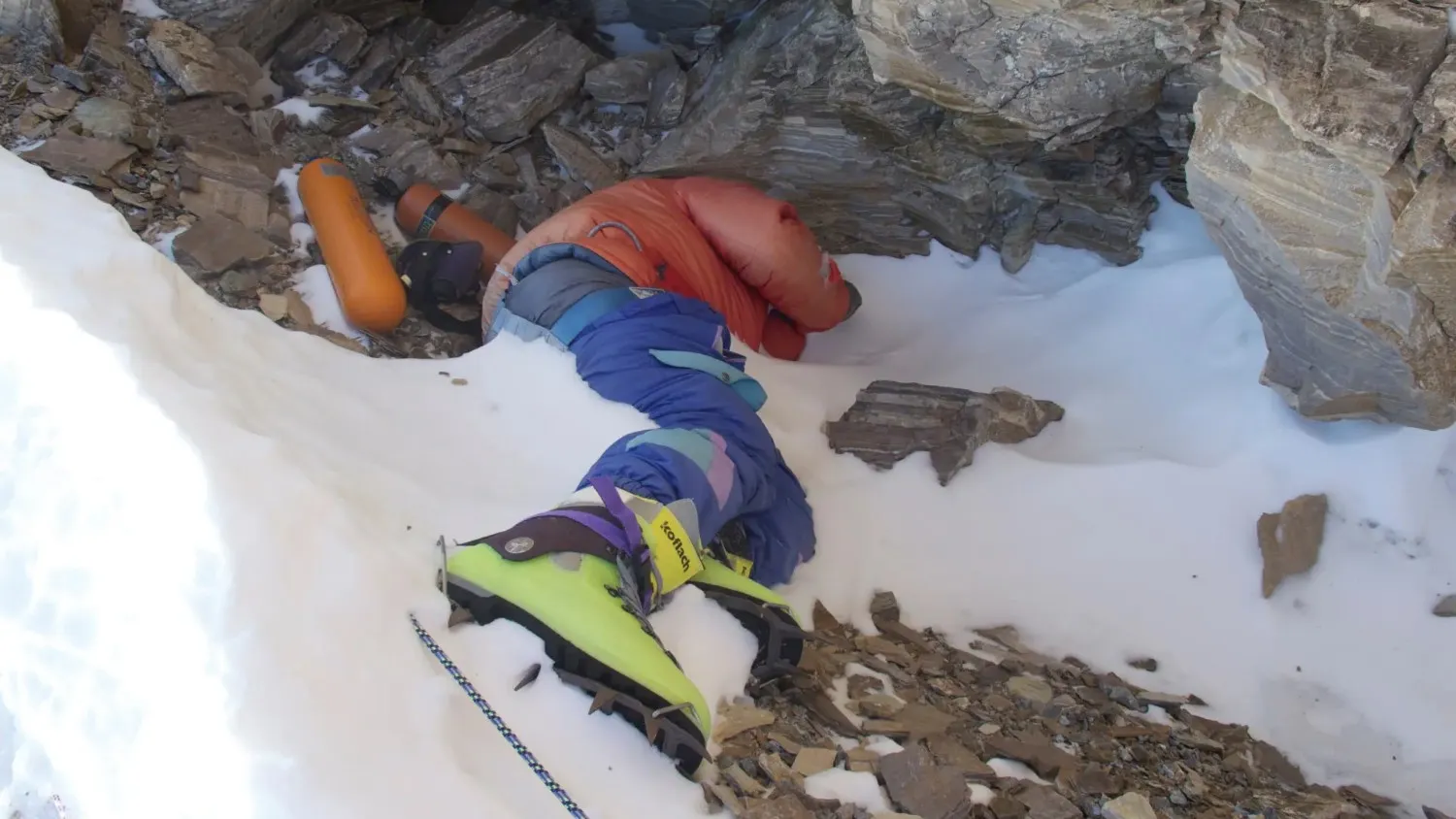
Green Boots Cave sits at approximately 8,500 meters (27,900 feet) on Mount Everest’s Northeast Ridge, the primary climbing route from the Tibetan side. The cave is located just beneath the First Step, approximately 350 meters below the summit. It sits directly on the route that nearly every climber ascending from the North Side passes.
The cave earned its name and its reputation because it sheltered the body believed to be Dorje Morup, an Indian climber who died during the 1996 Everest disaster. His bright green Koflach boots made him right away recognizable to passing climbers, and over the following years, “Green Boots” have become one of the most referenced landmarks within the Everest Death Zone. Guides used the cave to gauge progress, and climbers used it as a navigation checkpoint earlier than the technical sections ahead.
This guide explains the exact location of Green Boots Cave on Mount Everest. It also explains how the cave fits into the wider Northeast Ridge route, why it became so widely recognised, and what is known (and not known) about the site today.
Green Boots Cave Location (Quick Answer)
Green Boots Cave is positioned at approximately 8,500 meters (27,900 ft) on Mount Everest’s Northeast Ridge, on the Tibet (North) side climbing route. It sits just beneath the First Step and roughly 350 meters below the summit. Climbers at the Nepal (South) facet never pass this location, because it lies absolutely on the northern route.
| Detail | Information |
| Altitude | ~8,500 m (27,900 ft) |
| Route | Northeast Ridge, North Side |
| Country | Tibet (China) |
| Nearest landmark | First Step |
| Distance from the summit | ~350 meters |
| Zone | Death Zone (above 8000 m) |
| believed identity | Believed to be Dorje Morup |
| Visible from the South Route? | No |
This spot became a landmark not because climbers sought it out, but because the Northeast Ridge is slender, exposed, and offers few sheltered resting points. A small limestone alcove at this specific elevation was one of the few places to pause before the technical mountaineering began. That aggregate of location, elevation, and route layout is why it has become constant in Everest’s climbing records.
For a fuller photo of the person at the back of the name, see Who Was Green Boots?
Where exactly is the Green Boots Cave Location on Everest?
Green Boots Cave sits on Mount Everest’s Northeast Ridge, alongside the series of extreme-altitude landmarks that climbers skip among Camp VI and the summit. Climbers reach the cave shortly after crossing the Yellow Band and sit just before the First Step, making it one of the last resting spots before the path turns technical.
The full sequence looks like this as climbers ascend from the north:
- Camp VI
- Yellow Band
- Green Boots Cave
- First Step
- Second Step
- Summit Pyramid
Camp VI, the final camp, earlier than a summit push, sits at a height of 8,300 meters. From there, climbers cross the Yellow Band, a specific layer of sedimentary rock seen from a distance, earlier than reaching the small limestone alcove now called Green Boots Cave at about 8,500 meters. The cave is a small limestone alcove: a shallow rock recess, just massive sufficient for a climber to sit or take refuge from the wind before continuing upward closer to the First Step.
Because it sits directly at the constant-rope line used by almost all North Side climbers, it has become an unavoidable checkpoint rather than an area that everyone deliberately visits. Climbers moving slowly through the Death Zone could pass inside within a few feet on their way to the technical sections above.
It’s worth being clear on one factor that causes frequent confusion: climbers on the South (Nepal) route, who ascend through the Khumbu Icefall and South Col, do not pass this area. Green Boots Cave exists exclusively at the Tibetan facet of the mountain. For a broader comparison of the ways the 2 processes vary, see Everest North Side vs South Side Weather.
Why Did the Cave Become So Famous?
The cave has become famous because it sheltered the body widely believed to be Dorje Morup, an Indian climber who died at some stage in the 1996 Everest disaster, one of the deadliest seasons in the mountain’s mountaineering history. His bright green Koflach climbing boots gave the web page its lasting nickname and made it instantly identifiable to climbers passing on the constant ropes above.
Dorje Morup became part of an Indo-Tibetan Border Police expedition attempting the Northeast Ridge in May 1996, the same season that claimed numerous lives across both the North and South routes throughout an unexpected, excessive storm. He and his teammates were stuck in a deteriorating climate high on the mountain, and he did not live to tell the tale of the descent. His body came to rest in the small limestone alcove near the First Step, at an elevation at which recovery became, and stays, extremely tough.
Over the following long time, climbers on the North Side again and again passed within feet of the web page. Guides commenced the use of it as a casual marker of development toward the First Step, and the name “Green Boots” entered common use among mountaineers long before it reached wider public interest through books, documentaries, and news reports.
One crucial caveat merits mention: the identity related to the web page has never been formally confirmed through forensic verification. Dorje Morup is the widely accepted identity based on circumstantial proof, including his known course, device, and the timeline of his disappearance, but it remains an attribution rather than an actuality. For the fuller account of his story, read Who Was Green Boots?
Green Boots Timeline
| Year | Event | Why It Matters |
| 1996 (May) | An Indo-Tibetan Border Police expedition was caught in a severe storm during the 1996 Everest disaster. The climber believed to be Green Boots died near the First Step on Everest’s Northeast Ridge. | Marks the origin of the Green Boots story. |
| Late 1990s | The body became a recognizable landmark for climbers using the North Side route. | Guides and climbers began referring to the location as Green Boots Cave because of the bright green Koflach boots. |
| 2000s | The site gained international attention through books, documentaries, and media coverage about Everest. | Green Boots became one of the most widely recognized landmarks in the Everest Death Zone. |
| 2014–2017 | Multiple climbers reported that the body appeared to have shifted or become less visible. However, accounts differed and were never officially confirmed. | Introduced uncertainty about the body’s exact position and visibility. |
| Recent Years | Chinese authorities have carried out periodic Everest cleanup campaigns on the North Side, but no official statement has confirmed the current status of Green Boots. | The cave remains a well-known landmark, but the body’s present visibility remains unverified. |
Are Green Boots Still There Today?
No authentic source confirms the body’s current status or precisely what remains visible at the site today. Instead, climber accounts provide most of the available information, although no formal survey has verified these reports.
Several climbers who had visited the location after 2014 suggested that the body seemed to have shifted position or moved deeper into the cave, probably due to snow accumulation, wind exposure, or interference from passing traffic at the fixed ropes. Some recent expedition reports describe the site as less visible than in the past many years, even as others mention no noticeable change in any respect. These bills are inconsistent, largely anecdotal, and not independently tested.
It’s worth noting that the Chinese government, who control the Tibet facet of the mountain, has periodically limited access to and carried out cleanup operations on the Northeast Ridge in recent years, partly in reaction to overcrowding and environmental concerns. Whether such efforts affected this particular place has not been publicly documented in detail.
Given this uncertainty, the most accurate statement is a careful one: the body might still lie at or near the original site, but no one can confirm its current visibility with certainty. Anyone researching the subject should treat recent claims in either direction as unverified until a credible, dated source confirms them.
Why Were Green Boots Left on Everest?
Climbers left Green Boots on the mountain for the same reasons that apply to most fatalities above 8,000 meters. Recovery at that altitude is extremely risky, physically demanding, and often impossible to justify because it puts living climbers at risk.
The Death Zone offers approximately one-third of sea-level oxygen, which critically limits how much physical work a human body can safely carry out. Carrying a frozen body, frequently weighing well over 100 kg, as soon as encased in ice and tools, down technical, rope-constant terrain calls for energy and coordination that few climbers have left after their personal summit push.
Rescue groups additionally face a direct threat. Attempting a restoration diverts attention, oxygen, and rope assets away from the climbers certainly trying to summit or descend accurately. Several rescues on Everest have led to extra accidents or deaths among the rescuers themselves.
Cost is another issue. High-altitude body recovery operations can cost tens of lots of dollars and require specialized employees, helicopters when viable, and days of logistical planning, all in one of the most adverse environments on Earth.
For those reasons, more than two hundred bodies are believed to remain on Everest today. Green Boots is certainly the most identified example due to its fixed place immediately on the climbing path.
North Side vs South Side: Who Sees Green Boots?
Only climbers on Everest’s North Side path pass Green Boots Cave. Climbers on the South Side, via Nepal, follow a wholly different route and in no way encounter the site. This distinction causes frequent confusion because many people count on all Everest climbers to skip the same landmarks.
| Feature | North Side (Tibet) | South Side (Nepal) |
| Approach | Northeast Ridge | Khumbu Icefall, South Col |
| Passes Green Boots Cave | Yes | No |
| Base access | Tibet Base Camp (drive-in) | Trek via Khumbu Valley |
| Key technical sections | First Step, Second Step, Third Step | Khumbu Icefall, Hillary Step |
| Typical climber traffic | Historically lower | Historically higher |
The two routes diverge almost totally as soon as climbers leave base camp. They differ in terrain, technical needs, and even weather conditions. Trekkers who visit Everest Base Camp in Nepal, without trying a summit, are on the South Side. They are nowhere near the elevation or region of Green Boots Cave, which sits deep within the Death Zone on the alternative aspect of the mountain.
For a better examination of how conditions fluctuate between the 2 procedures, see Everest North Side vs South Side Weather. Anyone making plans for their personal Everest adventure, whether a trek or a complete day trip, benefits from understanding this route difference early in the planning process. Our team at Nepal Outdoor Expeditions can help clarify which route fits your dreams.
Why Is the Death Zone So Dangerous?
The Death Zone refers to elevations above 8,000 meters, where oxygen levels drop to roughly one-third of sea-level concentration. At this altitude, the human body cannot acclimatize, and every feature, physical and mental, starts to deteriorate the longer a climber remains there.
Low oxygen impairs decision-making first. Climbers file confusion, slowed response times, and bad judgment, even among skilled mountaineers. This is one purpose injuries cluster in this zone: the very altitude that makes the climb risky additionally reduces a climber’s potential to understand and respond to risk.
Physical conditions compound the risk. Temperatures often fall below -20°C, and wind speeds can exceed a hundred km/h, both stripping heat from the body some distance quicker than it could be replaced. Movement slows dramatically, considering each step requires disproportionate effort at this altitude. A climber who would possibly cover a kilometer in twenty minutes at sea level can take an hour or more here.
Exhaustion sets in quickly, and restoration is almost not possible without descending. Combined, those elements explain why the majority of Everest fatalities occur on this sector, and why landmarks like Green Boots Cave became so widespread. In an environment in which clear questioning and short choices are critical, fixed points on the route provided climbers something uncommon: facts about precisely where they stood.
Key Landmarks Near Green Boots Cave Location
Green Boots Cave sits among several different famous features on the Northeast Ridge. Understanding each allows place the cave inside the broader path.
First Step
The First Step is a rocky outcrop just above Green Boots Cave, at more or less 8,563 meters. It requires basic scrambling and marks the start of the course’s technical terrain, where climbers depend upon constant ropes for the first time on the summit push.
Second Step
The Second Step, at about 8,610 meters, is the most technically traumatic section of the North Route. It consists of a near-vertical rock face equipped with a hard and fast aluminum ladder, frequently called the Chinese Ladder, set up to assist climbers beyond an otherwise extremely tough pitch.
Third Step
The Third Step sits just beneath the summit pyramid, at around 8,700 meters. It’s shorter and much less technical than the Second Step, but climbers reach it when they are already significantly fatigued. This makes it a significant obstacle late in the ascent.
Rainbow Valley
Rainbow Valley lies elsewhere on the mountain and refers, somberly, to a stretch wherein more than one climber’s colourful gear has remained visible over the years. Learn more in Rainbow Valley, Everest North Side vs South Side.
Camp VI
Camp VI, at more or less 8,300 meters, is the final camp before a summit attempt on the North Route, and the place to begin for the main collection beyond Green Boots Cave.
Common Misconceptions About Green Boots
Several myths persist about Green Boots, frequently because insurance of Everest tends to blur info between the North and South routes.
- Are Green Boots on the Nepal route? No. The cave sits completely on the Northeast Ridge, accessed from Tibet. Climbers on Nepal’s South Route by no means skip this location.
- Can trekkers see Green Boots? No. Trekkers visiting Everest Base Camp in Nepal attain a maximum elevation of around 5,364 meters, a way below the 8,500-meter elevation of the cave, and on the other side of the mountain entirely.
- Is the cave near Everest Base Camp? No, on either side. Tibet Base Camp sits at roughly 5,150 meters, and Nepal’s Everest Base Camp sits at around 5,364 meters. Green Boots Cave is over 3,000 meters below both.
- Is the body nonetheless visible nowadays? This remains unconfirmed. Some climber reviews after 2014 endorse adjustments to visibility or position; no proven, dated source confirms the cave’s modern-day condition with fact.
For readers interested in an associated, nicely documented case involving a unique identification dispute on Everest, see Everest’s Sleeping Beauty: The True Story of Francys Arsentiev.
FAQs
Where exactly is Green Boots’ cave on Everest?
Green Boots Cave sits at about 8,500 meters (27,900 ft) on Mount Everest’s Northeast Ridge, on the Tibetan aspect of the mountain. It’s positioned just below the First Step, more or less 350 meters below the summit. It sits without delay on the fixed-rope line that North Side climbers use at some point of their summit push.
What altitude is Green Boots?
The cave sits at approximately 8,500 meters, placing it deep inside the Death Zone. This zone begins above 8,000 meters, where oxygen levels drop to about one-third of those at sea level. The cave lies between the Yellow Band below and the First Step above. Its location makes it one of the final resting points before the technical climb begins.
Is Green Boots still on Everest?
The body’s modern-day status is uncertain, and no legitimate source confirms its specific visibility nowadays. Some climbers who passed the site after 2014 said the body appeared to have shifted or moved deeper into the cave. However, these accounts are anecdotal and have not been independently confirmed.
Who was Green Boots?
Many climbers and historians believe the body belongs to Dorje Morup, an Indian climber and member of the Indo-Tibetan Border Police who died during the 1996 Everest disaster while attempting the Northeast Ridge. His bright green Koflach boots gave the site its lasting nickname, although experts have never published professional forensic confirmation of his identity.
Why wasn’t Green Boots brought down?
Recovery above 8,000 meters is extremely dangerous due to thin oxygen, extreme hypoxia, and technical terrain. Carrying a frozen body down exposed, rope-fixed sections calls for electricity, which few climbers have after their personal summit attempt, and beyond healing efforts, has led to additional accidents and deaths amongst rescuers.
Can trekkers visit Green Boots?
No. Trekkers at the famous Everest Base Camp trek in Nepal attain a maximum elevation of around 5,364 meters, over 3,000 meters below the cave’s region. Green Boots cave additionally sits on the opposite side of the mountain from the usual trekking course.
Are Green Boots on the Nepal or Tibet side?
Green Boots Cave is positioned completely on the Tibetan side, alongside the Northeast Ridge mountaineering route. Climbers ascending from Nepal’s South Side, via the Khumbu Icefall and South Col, by no means bypass this region in the course of their excursion.
How far is Green Boots from the summit?
The cave sits approximately 350 meters underneath Everest’s summit in vertical elevation, setting it within the final stretch of the climb, just before the technical sections at the First Step, Second Step, and Third Step begin.